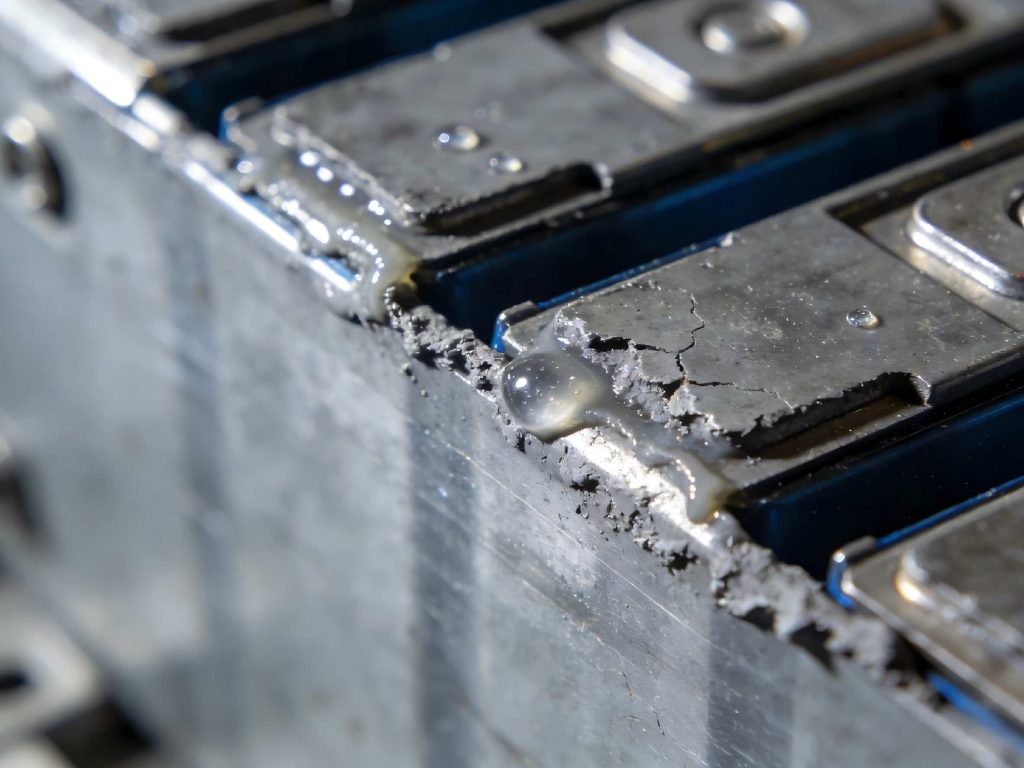

In today’s rapidly developing new energy vehicle market, the power battery pack, as the “heart” of the vehicle, directly impacts the vehicle’s range, safety, reliability, and overall lifecycle value through accurate performance evaluation. However, issues such as falsely labeled range and rapid battery degradation still frequently plague users and the industry. One root cause of these problems lies in the inaccuracy of data during the evaluation process. Guheng Energy understands that only reliable data based on high-precision testing can provide indisputable authoritative evidence for battery research and development, production, application, and even secondary use.
Why is accurate evaluation crucial?
The performance of a power battery is not a fixed value; its true capacity and cycle life are affected by multiple factors, including materials, processes, and usage conditions. Inaccurate evaluations can trigger a chain reaction: for OEMs, it may lead to overly optimistic range ratings, damaging brand reputation; for end users, it means unpredictable range anxiety and asset depreciation risks; and for secondary use scenarios such as energy storage, it directly affects the system’s economy and safety. Therefore, accurate power battery evaluation is not only a technical issue, but also the cornerstone of business and safety.
Core Evaluation Dimensions and Common Challenges
Evaluating power batteries hinges on electrical performance testing, with battery capacity testing and cycle life testing being the two main pillars.
Real-World Capacity Testing: A Benchmark for Usable Energy
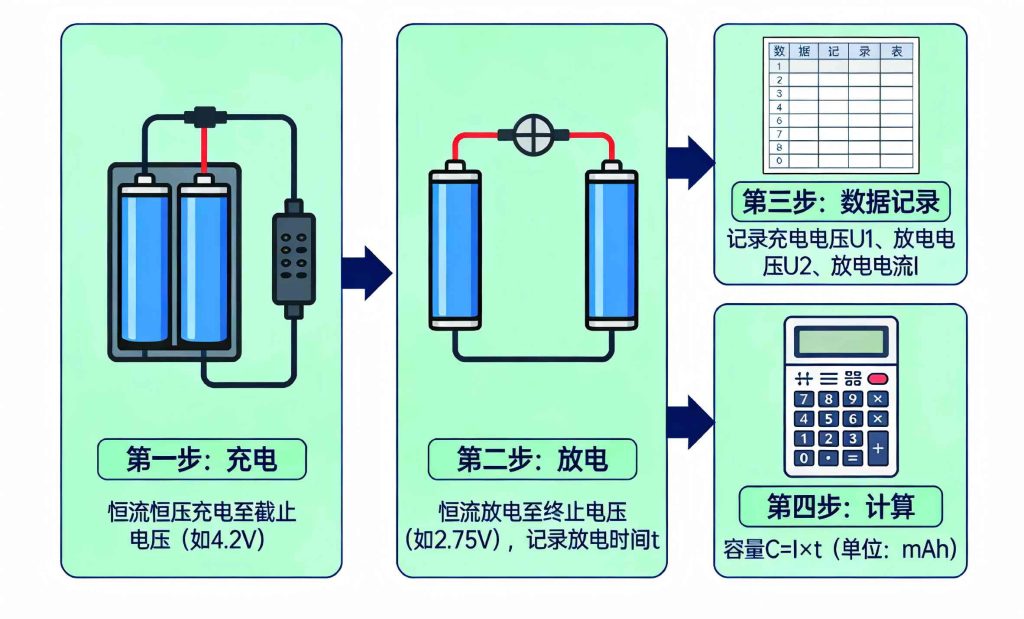
Battery capacity testing is far more complex than simply “charging and discharging.” It requires high-precision control to simulate standard or real-world operating conditions and accurately measure the total energy stored and released by the battery. Common challenges include: insufficient accuracy in voltage and current measurement and control of the charging and discharging equipment itself, leading to deviations in energy accumulation calculations; uneven temperature control during testing, affecting the internal chemical reactions of the battery and thus distorting the results. Tiny errors in millivolt-level voltage and milliampere-level current can be amplified into significant capacity deviations after long-term charge and discharge cycles.
Cycle Life Testing: Predicting Lifetime Value
Cycle life testing aims to predict the number of cycles required for battery performance to degrade to a certain threshold (e.g., 80% of rated capacity) by simulating long-term use. The challenge lies in how to scientifically accelerate testing without distorting the aging mechanism, and how to ensure precise consistency in the stress applied during each cycle (such as charge/discharge rate, cutoff voltage, and ambient temperature). The long-term stability, consistency, and data reliability of the testing equipment directly determine the accuracy of the lifespan prediction model.
How do high-precision testing systems overcome these challenges?
To obtain reliable evaluation data, a professional lithium battery charge/discharge testing system is essential. Such systems overcome these challenges through collaborative hardware and software design:
High-precision voltage and current control: This is the source of the data. The system needs to employ high-precision ADCs (analog-to-digital converters) and DACs (digital-to-analog converters), along with low-temperature drift sensors and sampling circuits, to ensure real-time monitoring and control of battery voltage and current at the microvolt and milliampere levels. Guheng Energy’s testing system is designed based on this concept, providing a reliable baseline for every measurement.
Fast dynamic response and low ripple: When simulating real-world driving conditions, the charging and discharging power of the battery changes drastically. The testing system must possess a dynamic response speed at the μs level and maintain extremely low output ripple to avoid causing additional stress to the battery or interfering with accurate measurements.
High energy feedback and stable grid support: During high-power discharge testing, energy is fed back to the grid with high efficiency (e.g., over 95% in the Guheng Energy system) instead of being converted into heat. This is a green, energy-saving, and sustainable testing method, while also avoiding instability in the testing environment caused by heat dissipation issues.
Intelligent software and data analysis: A powerful testing system relies on intelligent software. It should be able to execute complex multi-step testing processes (such as the national standard GB/T 31486 test), monitor data in real time, diagnose anomalies, and ultimately generate detailed analysis reports, intuitively displaying key parameters such as capacity, lifespan degradation curves, efficiency, and DCR changes.
Guheng Energy’s Solution: Empowering Authoritative Data
As a technology solution provider specializing in new energy testing, Guheng Energy’s lithium battery charge/discharge testing system was developed to meet these stringent challenges.
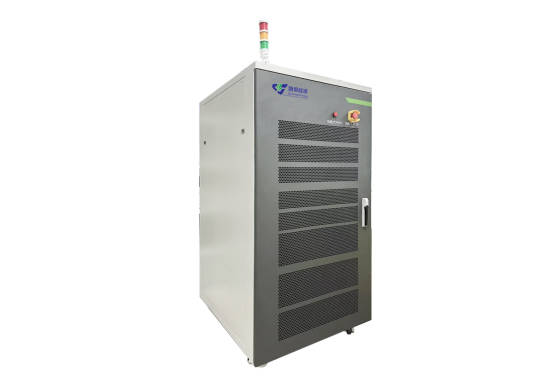
Our system is specifically designed for the R&D verification and off-line testing of battery modules, PACKs, and battery clusters. Taking one typical model as an example, it features dual-channel independent control capabilities, a voltage range covering 30V to 1000V, a maximum current of ±400A, and a maximum power of 200kW/250kW, meeting the testing requirements for battery packs from passenger cars to commercial vehicles. Its core advantage lies in achieving high-precision voltage and current control and measurement, ensuring data consistency and authority from the R&D laboratory to the production quality control line.
In practical applications, Guheng Energy’s testing system can seamlessly perform a series of electrical performance tests, including capacity, cycle life, operating condition simulations (DST, FUDS, etc.), and DC internal resistance (DCR). For example, in cycle life testing, the system can operate stably for extended periods, accurately recording capacity decay data for each cycle. Its high precision allows even minute decay of 0.1% to be reliably captured, providing a solid data foundation for establishing life models. In battery capacity testing, its high precision and low ripple characteristics ensure absolute accuracy in energy calculations under standard charge and discharge conditions, providing genuine evidence for the battery’s “nominal” capacity.
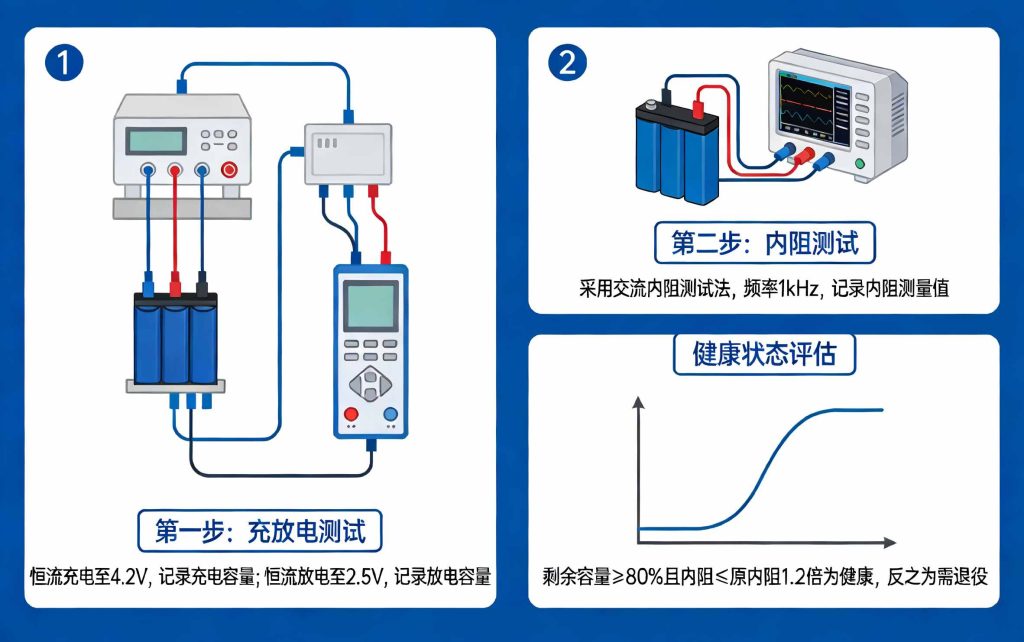
We are committed to standardizing and automating complex testing processes, helping customers establish a trustworthy power battery evaluation system. Whether for new product development and finalization or for precise diagnosis and sorting of the state of health (SOH) of retired batteries, Guheng Energy’s testing equipment is a powerful tool for obtaining decisive data.
Conclusion
Accurately assessing the true capacity and cycle life of power batteries is a crucial task spanning the entire battery lifecycle and connecting technology and the market. It requires testing equipment not only with powerful power output but also with the pursuit of ultimate measurement accuracy, stability, and intelligence. Guheng Energy will continue to focus on innovation in high-precision testing technology, providing reliable, efficient, and intelligent testing solutions to help the entire new energy industry eliminate performance illusions and drive a safe, reliable, and sustainable future based on real data.
FAQ
Q: Can we build a simple test bench ourselves for battery capacity testing?
A: While this might be sufficient for preliminary assessments with low precision requirements, it’s insufficient for the precise needs of R&D and quality control. Professional lithium battery charge/discharge testing systems far surpass simple assembly solutions in terms of voltage and current control accuracy, measurement resolution, dynamic response speed, data acquisition synchronization, and safety protection mechanisms. For example, Guheng Energy’s system ensures minimal cumulative energy error throughout the entire charge/discharge process, a feat difficult to achieve with ordinary equipment.
Q: Cycle life testing is typically extremely time-consuming. How can testing efficiency be improved?
A: Without violating scientific principles, accelerated aging testing methods can be employed, such as testing at higher rates, wider temperature ranges, or deeper depths of discharge (DOD), combined with mathematical models to estimate actual operating life. The key is that the testing equipment must be able to accurately and repeatedly apply these accelerated stresses. Guheng Energy’s testing system supports customized, complex testing steps and maintains long-term parameter stability, ensuring the reliability of accelerated testing.
Q: What is the most important test when evaluating retired batteries for secondary use?
A: The primary task is to quickly and accurately assess the current state of health (SOH), i.e., remaining capacity and power capability (internal resistance). This requires high-precision battery capacity testing and DC internal resistance (DCR) testing. SolidEnergy’s testing system can efficiently and in batches perform charge-discharge scanning and internal resistance testing on retired battery packs, quickly screening and classifying them, providing core data for the safety and economic assessment of their reuse.