


With the rapid development and popularization of new energy vehicles, the safety of their core power source—the battery system—has become a core focus for the industry and consumers. While pursuing higher energy density and longer driving range, a fundamental problem is increasingly prominent: how to ensure that the battery pack remains impenetrable under complex, variable, and even extremely harsh operating conditions? Once moisture or conductive impurities enter the battery pack, it may lead to decreased insulation performance, electrical short circuits, and ultimately, serious safety accidents such as thermal runaway. Faced with this critical juncture, traditional testing methods are increasingly showing their limitations; insufficient accuracy and low efficiency have become potential loopholes in quality control. This article will delve into the necessity of high-precision airtightness testing and reveal the urgent path for technological upgrades.
The Lifeline in Harsh Environments: Why Battery System Airtightness Cannot Be Lost
Battery packs do not operate in idealized experimental environments. Vehicles need to withstand torrential rain, high-pressure car washes, low air pressure in mountainous and plateau regions, and drastic temperature changes due to day-night cycles and seasonal transitions. These extreme conditions place near-stringent demands on the sealing performance of battery packs. Sealing here refers not only to the welds and joints of the battery casing itself, but also to various connectors and coolant piping interfaces on the casing where leaks may occur.
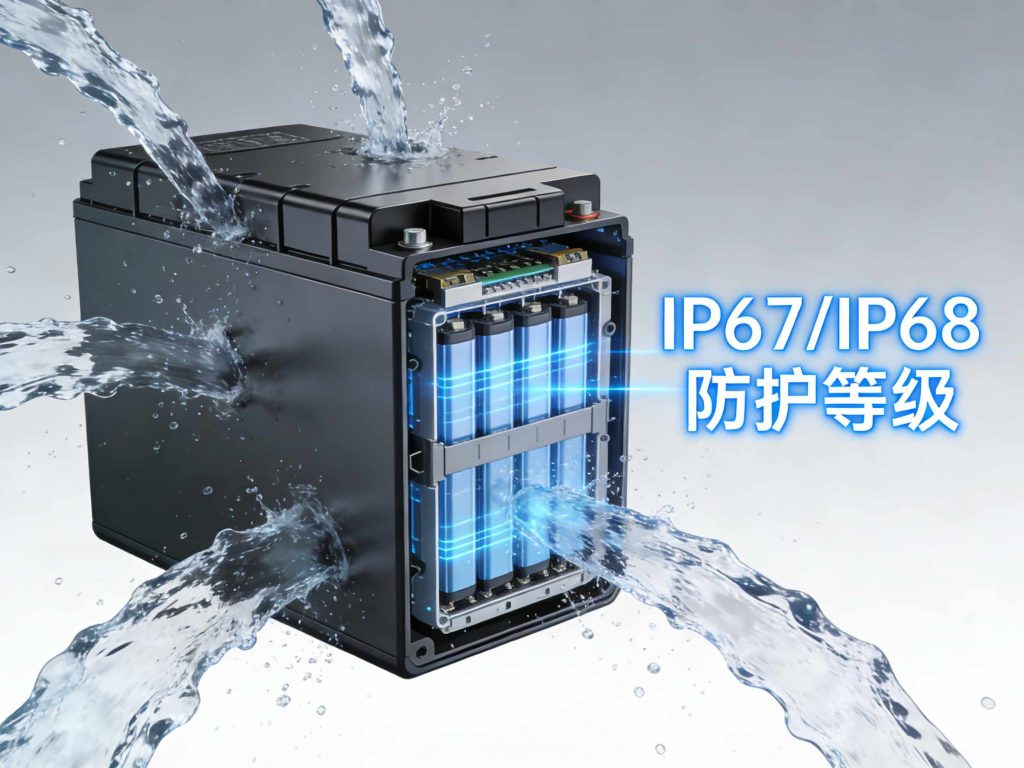
A successful airtightness test is significant far beyond simply meeting a standard (such as IP67/IP68 protection rating). It directly relates to the insulation safety, thermal management efficiency, and long-term reliability of the battery system. For example, sealing defects in the battery pack assembly can lead to moisture intrusion and internal condensation, causing a decrease in insulation resistance and creating safety hazards. Leaks in cooling system components, such as liquid cooling plates, can not only cause coolant loss and abnormal system pressure, but the leaking coolant can also lead to electrical insulation failures or localized corrosion. Both are significant long-term safety risks. Therefore, airtightness testing is the cornerstone of modern new energy battery safety, the first and most important technical line of defense for protecting users’ lives and property.
The Dilemma of Traditional Leak Detection Methods: Errors, Inefficiency, and Hidden Costs
For a long time, traditional methods such as the soap immersion test and the simple pressure drop test have been used in the industry. While these methods are simple and intuitive, their inherent defects have been magnified in the face of today’s high manufacturing standards.
The soap immersion test relies heavily on the operator’s visual observation and experience, and is almost powerless against micro-leaks and slow leaks. It also cannot provide a quantitative assessment, resulting in highly subjective results. The ordinary pressure drop test is easily affected by factors such as ambient temperature fluctuations and differences in test pipeline volume, resulting in poor pressure control, poor repeatability, and large errors. These detection methods, which rely on subjective judgment and lack precision, actually create huge hidden dangers for product quality. A tiny leak that goes undetected in the factory may develop into a major safety hazard after years of complex vehicle use, with the resulting hidden costs of after-sales maintenance and brand reputation damage far exceeding the investment in a single accurate test.
Towards High-Precision Detection: Key Technological Innovations
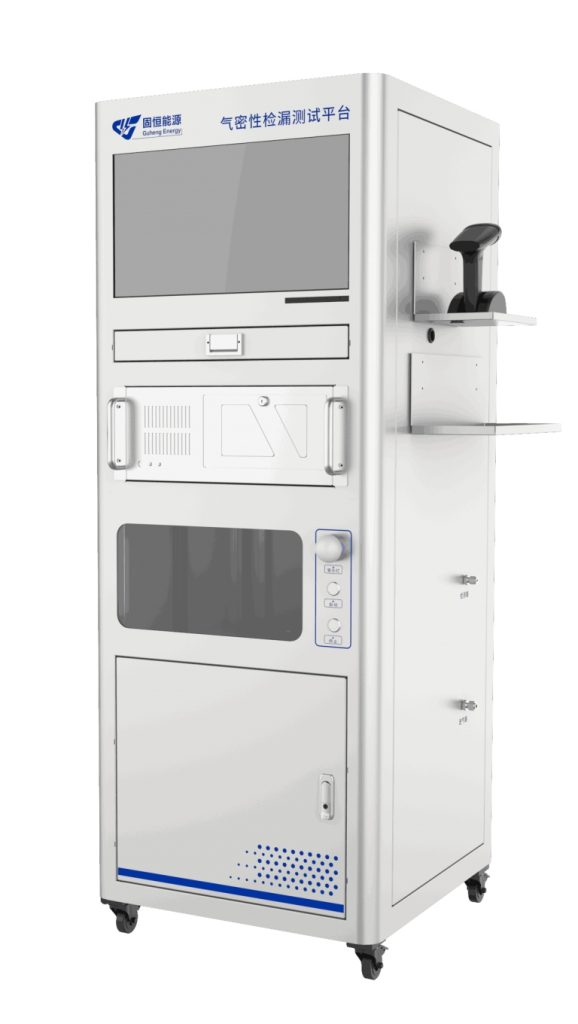
Recognizing the limitations of traditional methods and the industry’s need for upgrading, Guheng Energy, leveraging its deep technological expertise, has launched the new generation QMP series airtightness leak detection testing platform. This platform is specifically designed for the high-standard, high-speed production lines of the new energy industry, aiming to completely solve the pain points of traditional testing. Its core advantage lies in the deep integration of ‘high-stability pressure control’ and ‘real-time compensation for multiple parameters’. The platform employs precise closed-loop air pressure control technology, which can quickly and smoothly adjust and maintain the test pressure at the set value, ensuring the stability of test conditions from the source. Simultaneously, the system integrates a high-precision pressure sensor and a temperature compensation module, which can sense and correct the effects of ambient temperature changes in real time, ensuring highly accurate and repeatable test data.
Taking Guheng Energy’s Portable Air-tightness Leak Test Instrument QMP-ZK1-1 as an example, it not only achieves high-sensitivity and quantitative detection of leaks but also represents a leap forward in ease of use and intelligence. The equipment supports user-defined test plans and can automatically match parameters via barcode scanning. It features diverse communication interfaces (such as I/O, RS485, and CAN), allowing for easy integration with MES systems and automatic data upload and traceability. Its compact and portable structure, intuitive user interface, and optional printer for instant report output significantly improve on-site testing efficiency and quality management. For battery packs and liquid cooling plates of different shapes and sizes, we also provide professional customized chemical fitting design solutions to ensure accurate and efficient testing.
From Cost Center to Value Investment: Economic Analysis of High-Precision Testing
Shifting to high-precision testing is not only a necessary step to meet certification requirements but also a key measure to improve inherent product reliability from the source, reduce lifecycle risks, and build a brand quality moat. In today’s increasingly mature new energy vehicle industry, where consumer focus is shifting from range to safety and quality, manufacturing precision is the most powerful brand language.
By introducing high-precision airtightness leak detection testing platforms at key workstations on the production line (such as after battery pack assembly and packaging), companies can accurately intercept all sealing defects, achieving the quality goal of “no defects leaking out.” This not only significantly reduces after-sales risks and huge costs caused by leakage problems, but also elevates quality control from passive response to proactive prevention, laying a solid technical foundation for companies to establish a long-term, reliable quality reputation.
Conclusion
The journey of the new energy industry is vast and boundless, but every step forward must be based on safety. The airtightness of battery systems, this invisible “lifeline,” is calling for testing technology to move from experience to precision, and from extensive to intelligent methods. Traditional methods are no longer sufficient to shoulder the responsibility of protecting the future; technological upgrades are imperative. Guheng Energy is committed to providing the industry with reliable and advanced new energy service technology solutions. Our QMP series airtightness leak detection testing platforms and similar testing products embody this commitment. We believe that by empowering precision manufacturing with precision instruments, we can jointly build a Great Wall of safety for new energy vehicles and drive the entire industry steadily towards a safer and higher-quality future.
FAQ
Q: What are the main differences between the traditional pressure drop method and your high-precision testing platform?
A: The main differences lie in accuracy, efficiency, reliability, and intelligence. The traditional pressure drop method suffers from unstable pressure control and is easily affected by ambient temperature, resulting in large fluctuations in test results. Furthermore, it relies on manual timing and interpretation, leading to low efficiency and a high risk of misjudgment. In contrast, Guheng Energy’s QMP series platform utilizes patented, precise pressure control technology and multiple environmental compensations to stabilize testing conditions. It automatically and quickly completes high-precision measurements and intelligent judgments, providing digital and traceable results. It can also seamlessly integrate with production line systems for fully automated and efficient testing.
Q: Can Guheng Energy’s testing equipment adapt to our different types and sizes of battery boxes?
A: Absolutely. Guheng Energy provides not only standard equipment but also complete solutions. Our QMP series airtightness leak testing platform has powerful scheme editing and parameter setting functions. More importantly, we can provide professional, customized chemical clamp design and services based on the specific dimensions, structure, interfaces, and production line cycle requirements of your battery box or liquid cooling plate, ensuring that the equipment quickly and accurately adapts to your various product models, achieving flexible production testing.
Q: Will improving testing accuracy significantly impact our production costs?
A: In the short term, investing in high-precision equipment requires a certain upfront investment. However, from an overall operating and total cost of ownership (TCO) perspective, this investment offers a high rate of return. By preventing leaked products from entering the market, it directly avoids potentially huge after-sales repair, recall costs, and brand reputation damage. Simultaneously, its automated and efficient features save manpower, reduce waste of good products due to misjudgments, and improve overall production cycle time and quality control. Therefore, this is a key investment aimed at reducing long-term risks and enhancing overall competitiveness.