

With the accelerated global energy transition, the energy storage market is experiencing unprecedented explosive growth. To meet the demand for higher energy density, the individual capacity and system scale of energy storage battery packs are constantly expanding, which also poses stringent challenges to their safety throughout their entire life cycle. Among the many factors affecting the safety of energy storage batteries, the quality of the cell stacking process is the cornerstone determining the stability and consistency of the module structure, directly related to the level of ETS (Electrical, Thermal, and Structural Safety) risk of the battery pack.
As a professional manufacturer deeply rooted in the field of new energy service technology, integrating R&D, production, and sales, Guheng Energy understands the importance of controlling safety from the source. Today, we will delve into a core process in the large-scale manufacturing and maintenance of energy storage battery packs—the precise “extrusion technique” achieved through our CNC cell stacking extrusion machine—to see how it builds the first line of defense for energy storage safety.
Energy storage security: It starts with precise cell stacking
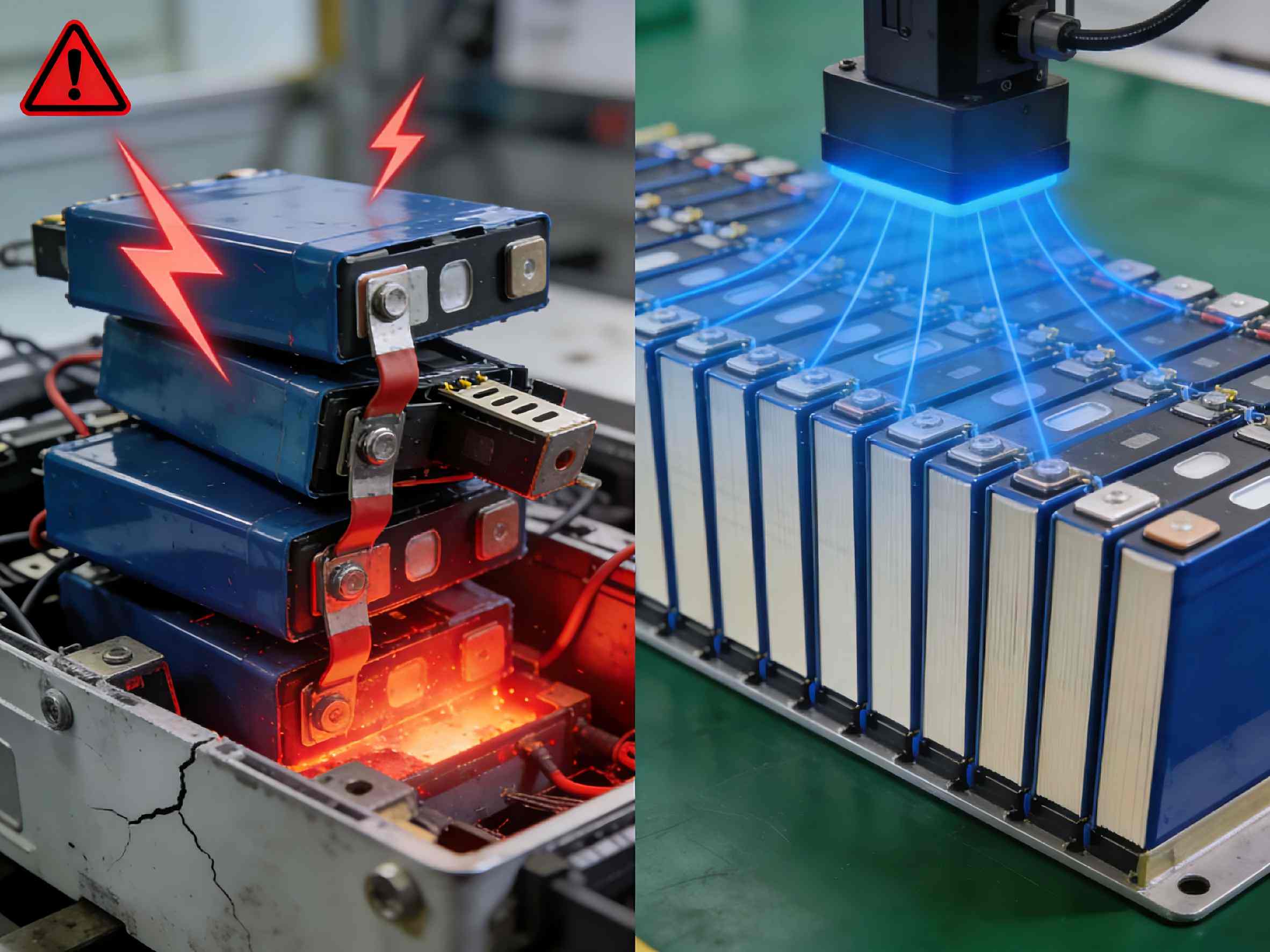
Large-scale energy storage systems consist of hundreds or thousands of cells precisely stacked and connected. During the long charge-discharge cycles of these cells, the internal active materials inevitably expand and contract. If the preload applied during stacking is insufficient or uneven, this periodic volume change will lead to loosening between cells, increased connection resistance, and deterioration of interface contact. These problems will not only accelerate battery capacity decay but may also cause internal short circuits due to localized stress concentration, ultimately triggering serious battery pack safety accidents.
Therefore, cell stacking is not a simple physical arrangement, but a precision engineering project concerning the health of the battery’s “skeleton.” Creating a long-term stable and uniformly stressed mechanical environment for the cells through scientific and controllable extrusion processes during the manufacturing stage is a key prerequisite for ensuring the safe and efficient operation of the energy storage system throughout its entire lifecycle.
Guheng’s “Extrusion Technique”: Reshaping Module Strength with Powerful Pressure and Ultra-High Precision
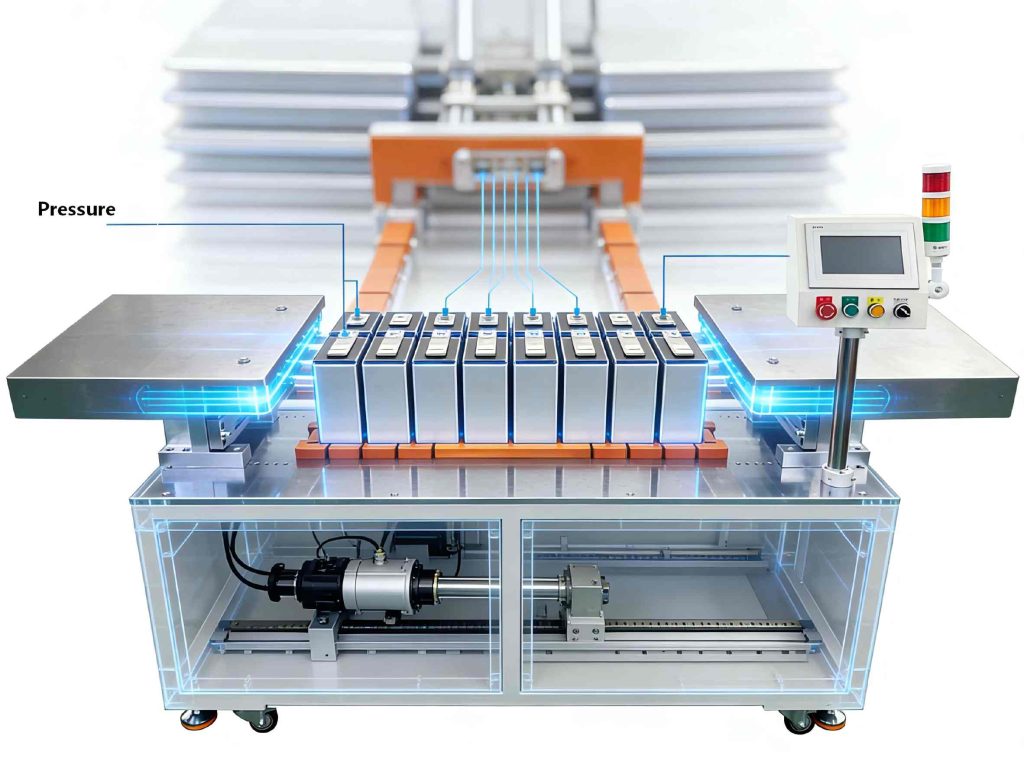
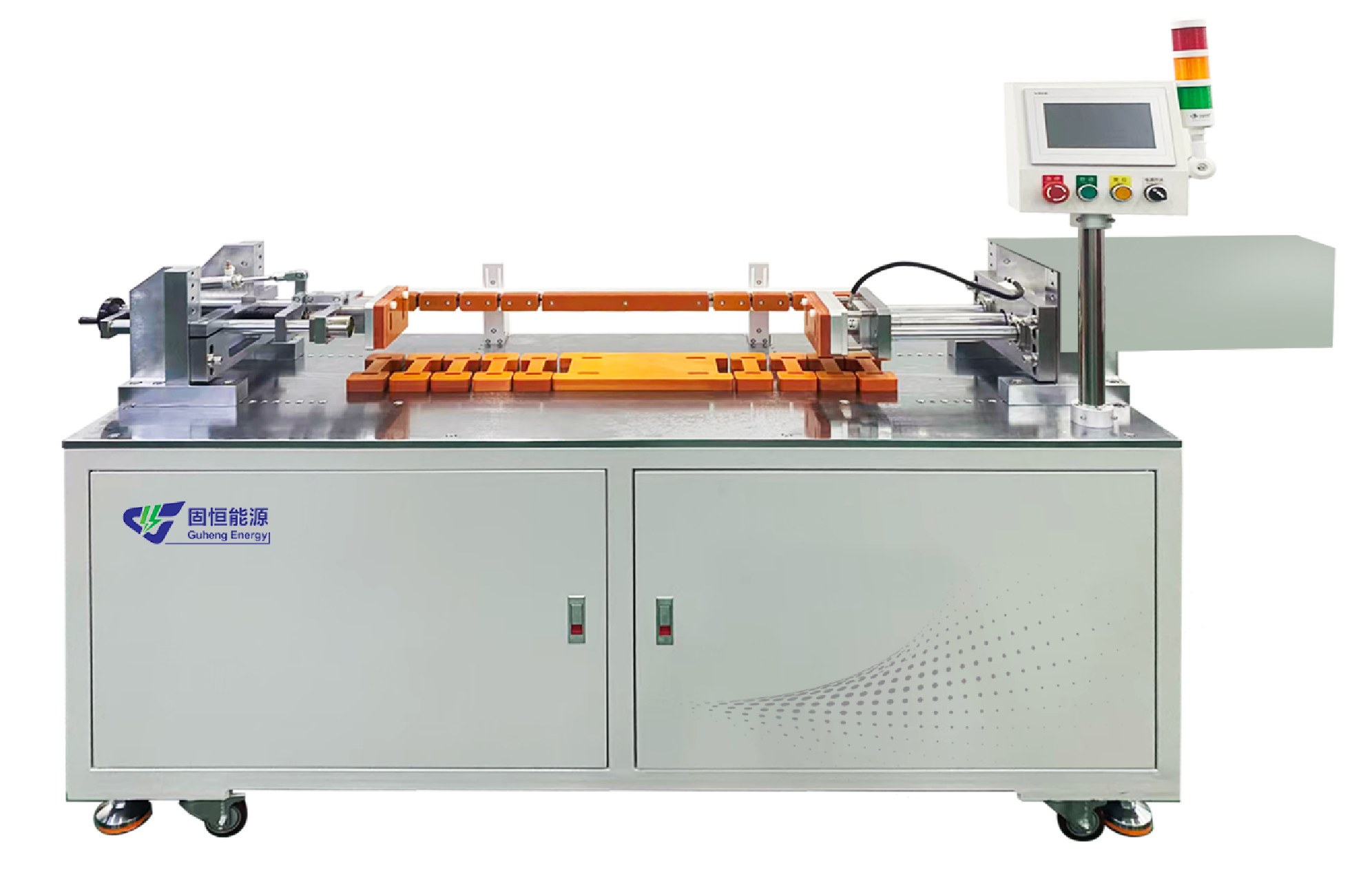
To address these pain points at the manufacturing stage, Guheng Energy has launched a core piece of equipment— a CNC cell stacking extrusion press. The core value of this equipment lies in its superior extrusion capability and ultimate process control.
First, it boasts a high compression pressure range of 0-1200kg with high pressure regulation precision. This powerful “compression technique” can apply sufficient and precise pre-tightening force to large energy storage modules, effectively suppressing excessive expansion of the cells during subsequent use, ensuring optimal contact between cell electrodes and between cells, thereby significantly enhancing the overall structural strength of the module.
Secondly, the extrusion movement repeatability of this equipment is as high as ±0.05mm. This means that in continuous mass production, the position and force of each extrusion can remain highly consistent, creating a uniform stress environment for the battery cells and avoiding the risk of localized failure due to uneven pressure. It is this millimeter-level control over pressure and position that lays a solid foundation for the consistency and long-term reliability of energy storage batteries from the source, effectively addressing the ETS risk caused by structural problems.
Large-scale compatibility: flexibly meeting diverse energy storage manufacturing needs
The current energy storage market features a diverse range of product forms, from standard 280Ah cells to longer 314Ah+ cells, with battery pack sizes constantly evolving. This places extremely high demands on the compatibility of stacking equipment. Guheng Energy’s CNC cell stacking extrusion machine is well-versed in this, with its design fully considering the flexibility of future product iterations.
The equipment boasts a compact body measuring 2330*650*1370mm ( length, width , and height ) and is equipped with an extrusion stroke range of 200-1100mm, flexibly compatible with various mainstream and future large-scale energy storage cell modules with lengths ranging from 200-1100mm , widths from 200-400mm , and heights from 120-280mm .
This “large tabletop, long stroke” design allows energy storage companies to complete the precision stacking of multiple module specifications on a single machine, greatly improving the flexible manufacturing capabilities and equipment utilization of the production line, and meeting the customized production needs of different customers and projects.
Beyond manufacturing: Safeguarding the safety of energy storage throughout its entire lifecycle
As a leading battery testing equipment company, GHUENG Energy’s vision extends beyond manufacturing. We understand that superior manufacturing ensures safer and more reliable batteries throughout their long lifespan. Our high-quality modules, produced using our CNC cell stacking extrusion machine, exhibit stable internal structures and better expansion consistency, creating favorable conditions for subsequent battery pack ETS management (especially the efficient operation of the thermal management system).
This “safety gene” injected from the manufacturing source complements our subsequent series of testing and maintenance equipment. Whether it’s using our Battery Pack Service Terminal Final Inspection Instrument (EOS-TEST) for comprehensive performance evaluation before the battery pack leaves the production line, providing reliable data for battery health status diagnosis during operation and maintenance, or using emergency response kits and other safety equipment in emergency situations, Guheng Energy is committed to providing energy storage customers with professional technical support throughout the entire “manufacturing – testing – operation and maintenance” chain.
Conclusion
Energy storage safety begins with the smallest details and is perfected through meticulous craftsmanship. The seemingly basic process of cell stacking is actually the “stabilizing force” protecting the safety of energy storage systems. Guheng Energy’s precise “extrusion technique,” achieved through a CNC cell stacking extrusion machine, is precisely designed to solidify this foundation.
We use a powerful pressure of up to 1200kg, precise positioning of ±0.05mm, and a large platform compatible with modules of 200-1100mm in length to lock in the structural strength of each energy storage battery pack, resisting ETS risks.
On the journey to achieve higher energy density and superior safety performance, Guheng Energy is committed to continuous technological innovation, working hand in hand with global energy storage partners to jointly build a robust safety defense. If you wish to introduce more advanced and reliable manufacturing processes to your energy storage battery production line, please contact us for customized technical solutions.
FAQ
Q: What is the battery pack ETS , and how does it relate to the stress of cell stacking?
A: Battery pack ETS stands for Electrical, Thermal, and Structural Safety, and is a key indicator for evaluating the overall safety performance of a battery pack. The pressure applied during cell stacking directly affects ETS : improper pressure can lead to electrode misalignment and lithium plating (electrical risk), or increased contact resistance causing localized overheating (thermal risk), while also weakening the module’s impact resistance (structural risk). Therefore, applying precise and uniform pressure using equipment like the CNC cell stacking extrusion machine from Guheng Energy is a core means of controlling battery pack ETS risks at the source.
Q: Why is cell stacking and extrusion necessary during the manufacturing process of energy storage batteries?
A: During charge-discharge cycles, the cells of an energy storage battery repeatedly expand and contract. Without proper pre-tightening, gaps will form between the cells due to expansion, leading to loose connections, increased resistance, accelerated capacity decay, and potentially safety hazards. Applying appropriate pre-tightening force through compression can effectively suppress excessive cell expansion, ensuring long-term tight contact at the interfaces, thereby significantly extending the battery pack’s lifespan and improving its safety.
Q: How to ensure the consistency of individual cells within a battery pack after cell stacking?
A: The key to ensuring consistency lies in the precision and control capabilities of the stacking equipment. Guheng Energy’s CNC cell stacking extruder, through its servo control system, can precisely control the pressure (adjustable from 0-1200kg) and application direction. Combined with a repeatability accuracy of up to ±0.05mm, this ensures that each cell on the entire platform experiences uniform stress. This uniform initial stress environment guarantees that the expansion space and operating state of each cell remain consistent throughout its lifespan, effectively maintaining the high performance and high reliability of the entire energy storage system.
Q: How does the extrusion process specifically help prevent battery thermal runaway ( ETS )?
A: Thermal runaway is often caused by internal short circuits. Optimized extrusion processes firstly prevent the separator from thinning or breaking due to excessive expansion of the cell via precise pre-tightening force; this is the first physical barrier against internal short circuits. Secondly, uniform pressure ensures the uniformity of lithium-ion migration within the cell, reducing the risk of lithium dendrite formation due to excessive local current. Finally, good structural stability ensures a tight fit between thermal management components (such as liquid cooling plates) and the cell surface, improving heat dissipation efficiency and effectively suppressing thermal propagation in its early stages.