

In today’s pursuit of high energy density and long range, the safety and reliability of power battery packs remain the core challenges and primary considerations for the industry. People often focus on macroscopic safety tests such as needle penetration and compression of battery cells, easily overlooking a lurking “invisible killer”—micro-leakage of electrolyte. It is silent, but its destructive power accumulates over time, potentially leading to catastrophic consequences. Today, we will delve into this hidden danger and analyze how Guheng Energy, with its QMD series of portable electrolyte leak testers, can build a precise and efficient safety defense for you.
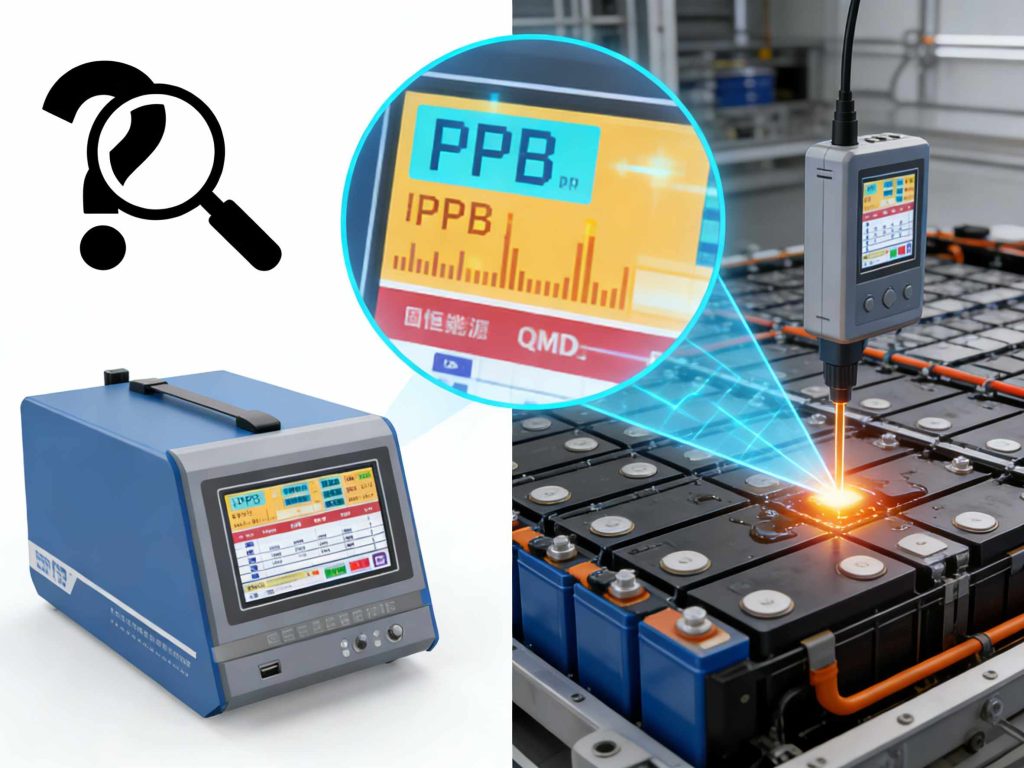
Potential Hazard Analysis of Micro-Leakage of Electrolyte
The seemingly robust battery pack casing contains hundreds or thousands of battery cells. During production, assembly, or use, micron-level defects may appear in the cell’s terminal seals, explosion-proof valves, or casing welds due to stress, flaws, etc. These defects can lead to extremely slow vapor or liquid leakage of the electrolyte, completely undetectable by traditional visual inspection. The harm caused by this micro-leakage is gradual and potentially fatal, primarily manifested in three aspects:
- Irreversible corrosion and structural damage: The electrolyte is highly corrosive. Once leaked, it continuously corrodes critical components inside the battery pack, such as copper busbars, connectors, and sampling circuit boards, leading to increased contact resistance, localized overheating, and even open circuits. Simultaneously, it corrodes the battery pack casing and connectors, compromising their IP protection rating and allowing external moisture to penetrate more easily, creating a vicious cycle.
- Potential trigger for internal short circuits and thermal runaway: Leaking electrolyte can create conductive paths between cells or between cells and module structural components, significantly increasing the risk of internal short circuits, which are a key link in triggering a chain reaction of thermal runaway.
- Accelerated performance degradation and lifespan reduction: The electrolyte is the essential medium for lithium ion migration between the positive and negative electrodes. Insufficient electrolyte levels severely degrade ion transport efficiency, leading to a sharp increase in battery internal resistance and electrochemical polarization, resulting in rapid capacity decay and significant reduction in cycle life. Microleakage signifies the continuous loss of active material, directly manifesting as accelerated capacity decay and a significant increase in internal resistance, causing the battery pack to be retired far before reaching its designed lifespan.
From “Undetectable” to “Precise Quantification”
Traditional detection methods are inadequate for micro leakage. Visual inspection is powerless; insulation resistance testing, while capable of detecting problems, cannot pinpoint the leak source and lacks sensitivity; gravimetric methods are highly susceptible to environmental interference, inefficient, and cannot perform online or in-situ detection on already packaged battery packs.
The industry urgently needs a detection method that can achieve early, quantitative, and precise location of leaks. This is precisely the initial motivation behind Guheng Energy’s development of the QMD series portable electrolyte leak tester—to control risks at their inception.
How Guheng Energy’s QMD Series Became a “Precision Detection Instrument”
The success of Guheng Energy’s QMD series stems from its profound understanding of detection principles and the deep integration of two core technologies.
Creating a Stable Detection Environment
This technology is a prerequisite for detection. The QMD series can apply a stable and controllable micro-positive or micro-negative pressure environment inside the battery pack. This step is crucial; it not only simulates the pressure stress that batteries experience due to temperature and altitude changes during actual operation, but also establishes a stable pressure difference inside and outside the battery pack through precise pressure control. This causes internal gases (including potentially leaking electrolyte vapor) to escape through the leak point, creating conditions for subsequent precise detection. The entire process is completed automatically, achieving rapid pressure balance and stabilization.
Highly Sensitive Response to Trace VOCs
This sensor constitutes a key component of the detection system. The QMD series uses an imported high-precision photoionization (PID) sensor. PID technology exhibits extremely high sensitivity to volatile organic compounds (VOCs), and battery electrolytes are a typical source of VOCs. When trace amounts of electrolyte vapor, “forced out” by gas pressure, pass through the sampling system, the PID sensor can accurately identify its concentration, enabling early detection of electrolyte leaks at concentration levels as low as ppm or even ppb.
Beyond Single-Function Product Matrix
In the field of battery manufacturing and maintenance, safety and efficiency are a system engineering project. In addition to core leak detection, Guheng Energy provides comprehensive solutions. For example, on the production line, an airtightness tester can be used to rigorously test the welding and sealing performance of the battery pack casing before electrolyte injection, serving as the first line of defense against leaks. In subsequent maintenance, the BPS series battery performance tester can comprehensively assess the battery’s capacity, internal resistance, and other health conditions, corroborating the results of the QMD test to provide customers with a more comprehensive battery health report.
Comprehensive Protection from Production Line to Energy Storage Power Station
The portable design of Guheng Energy’s QMD series allows its value to be maximized in multiple key scenarios.
Battery OEM Production Lines and Quality Gates
In the final testing stage after battery pack assembly, the QMD (Quality Management Device) is integrated as a crucial offline or online 100% inspection station. Its optional barcode scanner and multiple communication interfaces (such as RS485 and CAN) allow for seamless integration with your MES (Manufacturing Execution System) for automatic data upload and precise traceability. Optional I/O control signal functions can be directly integrated into automated production lines for unmanned operation.
Regular Inspections and Fault Diagnosis in Energy Storage Power Stations
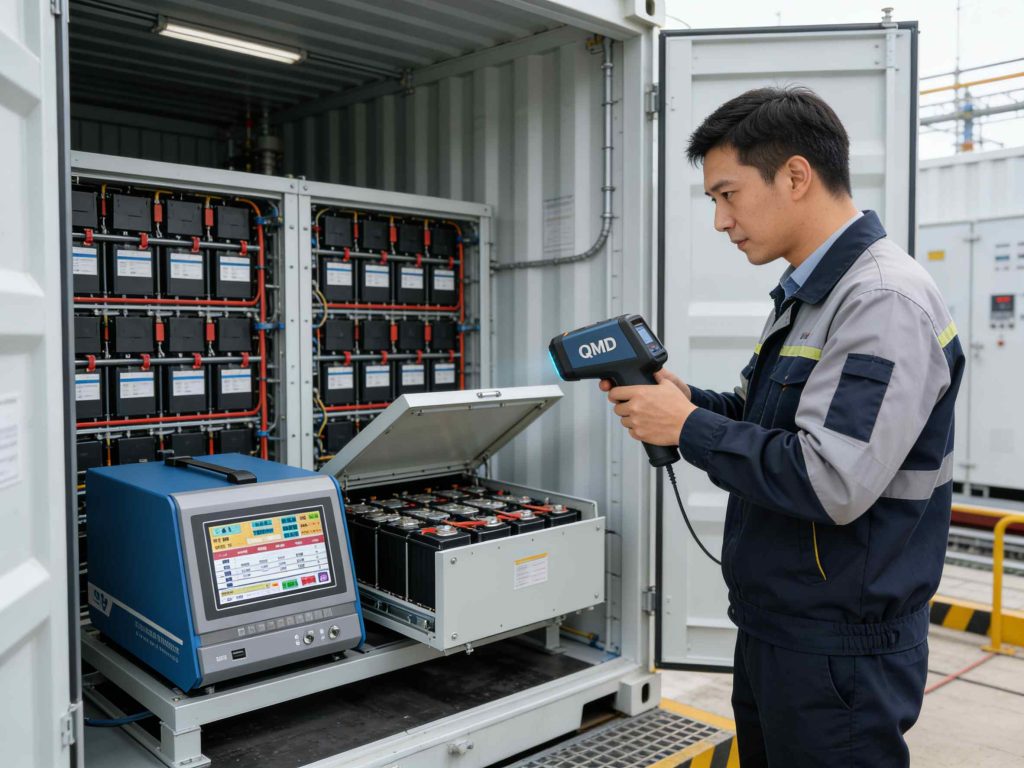
Regular maintenance is crucial for in-service energy storage power stations. Maintenance personnel can easily carry a QMD to quickly scan and inspect any battery cluster within the energy storage container. When the BMS (Battery Management System) alarms or the BPS (Battery Performance Tester) detects an anomaly in a battery pack, the QMD can be used for specialized leak diagnosis to quickly determine if electrolyte leakage exists, enabling precise repairs, avoiding unnecessary replacements, and saving high costs.
Building a solid foundation for safety with precise detection
Electrolyte micro-leakage is a critical issue that is easily overlooked but has significant potential impacts (involving safety and lifecycle costs). Guheng Energy, as a provider of new energy service technology solutions and testing instruments, deeply understands the importance of “prevention is better than cure.” Our QMD series portable electrolyte leak testers are not just products, but a precise and reliable safety solution that we contribute to the industry. They help our customers avoid quality incidents at the source, enhance product reputation, and protect the lives and property of end users.
We believe that adopting cutting-edge detection technologies like the QMD series and incorporating micro-leakage detection into standard procedures is an inevitable step for the entire industry towards higher quality and greater safety.
FAQ
Q: What are the main advantages of Guheng Energy’s QMD series portable electrolyte leak testers?
A: Its main advantage lies in the combination of high-precision PID detection and dedicated air pressure control technology, enabling ultra-early micro-leakage detection at the PPB level. Meanwhile, its portability and rich optional functions (such as barcode scanning, communication, and cloud data) enable flexible integration into production lines and on-site maintenance, providing a closed-loop solution from production line testing to on-site maintenance diagnosis, and even data traceability and management.
Q: Can the QMD series be integrated into existing battery pack production lines?
A: Absolutely. The QMD series offers a rich selection of communication interfaces, such as RS485/RS232 and CAN, and can be configured with I/O control signals. It can easily interface with your PLC or MES system to achieve automated testing, automatic data uploading, and product ID binding, seamlessly integrating into existing production lines.
Q: What should the electrolyte leak detection cycle be?
A: For battery manufacturers, it is recommended to perform 100% online testing on every battery pack leaving the factory. For in-service energy storage systems or vehicles, it is recommended to develop a regular preventative maintenance plan (such as quarterly or semi-annually) based on battery operating data, and to immediately use the QMD for fault diagnosis when any performance abnormalities are detected.
Q: Do PID sensors need to be replaced frequently?
A: The high-performance PID sensor used in the Guheng Energy QMD series has a typical lifespan of thousands of hours for its core detection component (UV lamp). Under normal use and with adherence to regular calibration procedures, replacement frequency is low. The equipment features self-diagnostic and maintenance reminder functions, effectively managing maintenance costs.
Q: Besides electrolyte leakage, does Guheng Energy offer detection solutions for other risks to battery packs?
A: Yes. We provide comprehensive testing solutions. For example, airtightness testers are used for casing sealing tests; the BPS series battery performance testers are used to assess the overall health of the battery; in addition, we also have insulation resistance testers and other products, collectively building a comprehensive, multi-layered battery safety testing system for our customers.