

Troubleshooting 48V micro-hybrid batteries cannot rely solely on fault codes. A more reliable approach is to cross-verify BMS communication, charge/discharge response, SOC, group terminal voltage, individual cell voltage, and protection records within the same process to first determine whether the anomaly originates from the battery itself, the connection path, or control conditions.
What should be confirmed first when diagnosing a 48V mild hybrid battery fault?
Differentiating between battery pack malfunctions and connectivity/communication issues
When starting a repair, first confirm the battery pack terminals, data acquisition connection, and BMS power supply status, and then read the communication information. If the CAN message is interrupted, the isolation DIO signal is abnormal, or the 12V power supply is unstable, drawing conclusions solely based on the SOC or fault codes can easily misdiagnose communication problems as cell problems.
Establish repeatable detection conditions
Record the battery’s initial SOC, group terminal voltage, individual cell voltage, and temperature, and maintain consistency in connection sequence, ambient temperature, and test parameters. This ensures that during retesting, it can be determined whether the anomaly has changed with operating conditions, rather than being influenced by a single, occasional reading.
How charge and discharge data can help locate anomalies
Observe the response using CC/CV charging and CC discharging.
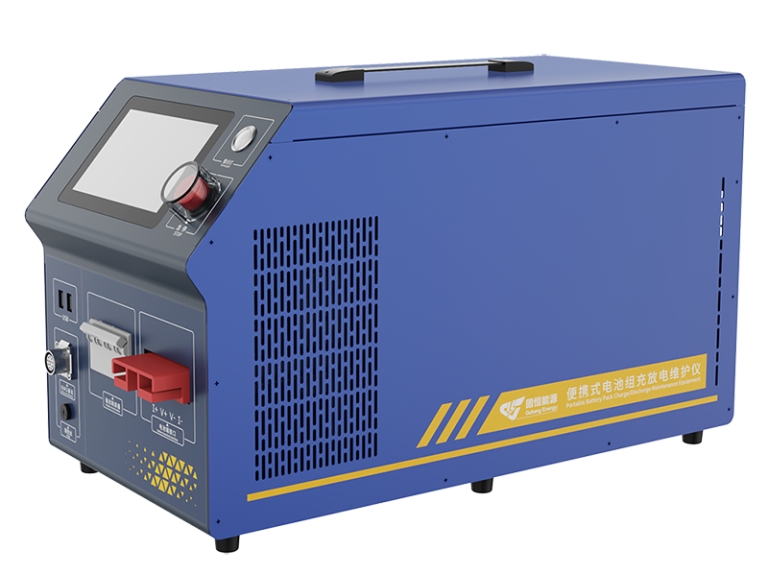
During the charging phase, the smoothness of the transition from constant current to constant voltage can be observed. During the discharging phase, attention should be paid to whether the current build-up, the drop in terminal voltage, and whether the stopping conditions are triggered as expected. The PBM-MW-D-60/08 provides 8A charging and 4A discharging, and supports CC/CV charging and CC discharging modes, which can be used to form comparable response records.
Compare SOC, group terminal voltage and individual cell voltage
An abnormal SOC does not necessarily mean the battery is damaged. If the SOC change is consistent with the group terminal voltage, but the voltage of a certain individual cell deviates for a long time, the focus of the investigation should shift to the consistency of individual cells, the data acquisition path, and temperature conditions; if multiple quantities change simultaneously, the connection, BMS communication, and protection status should be checked first.
Why BMS communication cannot be taken as a conclusion on its own?
The role of CAN and isolated DIO signals
The communication data reflects the BMS’s judgment of the battery status, but the maintenance instrument still needs to cross-confirm using physical quantities such as voltage, current, and temperature. The PBM-MW-D-60/08 supports 12V power supply and CAN isolated DIO signals, and can complete protocol diagnostics while maintaining clear communication boundaries.
LCU communication and 12V output check boundaries
When LCU communication or 12V start-up lead-acid battery charging is involved, the auxiliary power function and the 48V main battery test should be recorded separately. This can verify the auxiliary link and avoid bringing 12V side anomalies into the 48V conclusions.
How multi-level protection reduces missed detections and false alarms
The difference between cutoff conditions and protection conditions
Group terminal voltage, SOC, and individual cell voltage can be used as process cutoff conditions to determine when the test ends; reverse connection, disconnection, short circuit, overcurrent, overtemperature, and individual cell voltage over/under are protection conditions used to stop or limit operation when risks occur. These two types of records should be viewed separately.
Seeking clues from preservation records
If the disconnection or reverse connection protection is triggered at the beginning of the test, prioritize checking the wiring and polarity. If overheating or individual unit voltage exceeding limits occurs after running for a period of time, the problem should be located by combining temperature, SOC, and charge/discharge stages. Multi-level protection allows the service station to further break down “cannot operate” into manageable causes.
How can Guheng Energy’s solutions be integrated into the service station process?
Parameter settings, automatic operation, and USB flash drive recording
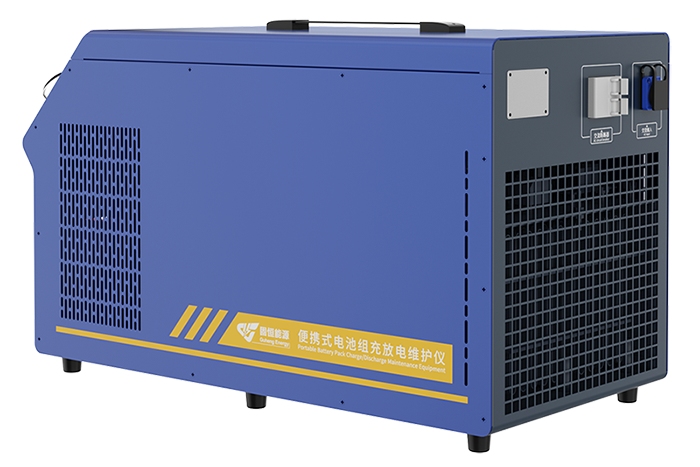
Guheng Energy’s portable 48V micro-hybrid battery pack maintenance instrument can automatically run and terminate after setting conditions such as pack-end voltage, SOC, and individual cell voltage, and the running data can be saved to a USB flash drive. It features a 3.5-inch color touchscreen, customizable 1–8 pack-end channels, and RS485, CAN, Ethernet, and GPRS interfaces, facilitating the integration of on-site retesting into existing maintenance processes.
The value of portable devices in on-site retesting
The device has dimensions smaller than 350×250×170mm, is air-cooled, and operates at temperatures ranging from -20 to 50℃, making it suitable for repeated testing at maintenance stations. For information on product connection methods and applicable boundaries, please refer to the 48V micro-hybrid battery pack maintenance instrument product page and develop testing procedures based on your specific battery pack interface.
in conclusion
High-quality fault diagnosis of 48V mild hybrid batteries essentially involves linking communication judgments, charge/discharge responses, individual cell differences, and protection records into a reproducible chain of evidence. Guheng Energy’s portable maintenance equipment allows repair personnel to perform parametric testing, automatic termination, and data retention on-site, transforming ambiguous alarms into clear directions for handling. Understanding Guheng Energy’s battery maintenance solutions helps establish stable retesting processes for repair stations.
FAQ
Q: Does an abnormal SOC of a 48V mild hybrid battery necessarily mean that the battery is damaged?
A: Not necessarily. SOC is a state quantity estimated by the BMS based on voltage, current, temperature, and algorithms. Anomalies may arise from communication interruptions, acquisition deviations, temperature changes, or individual cell consistency issues. SOC, group terminal voltage, and individual cell voltage should be compared simultaneously, and the battery should be retested under consistent conditions before judging the battery itself.
Q: Why is it necessary to check both the group terminal voltage and the individual cell voltage simultaneously during fault diagnosis?
A: Group terminal voltage reflects the overall output, while individual unit voltage shows local deviations. Looking only at group terminal data may mask anomalies in a particular unit; looking only at individual unit data may overlook terminal, relay, or main circuit problems. Only by combining both can one distinguish between overall and local faults.
Q: Can the PBM-MW-D-60/08 maintain a 12V starting battery?
A: This device is designed for 48V lithium battery pack maintenance, while also supporting 12V start-up lead-acid battery charging or discharging extension, and providing 12V power output and LCU communication functions. In actual use, the 12V auxiliary function and the 48V main battery testing should be managed separately according to the device menu and on-site wiring requirements.
Q: How should service stations maintain 48V mild hybrid battery test records?
A: It is recommended to retain battery identification information, initial SOC, group and individual cell voltages, temperature, charge/discharge mode, cutoff reason, and protection trigger records for each test. The PBM-MW-D-60/08 supports storing operating data on a USB flash drive, facilitating retesting, comparison, repair handover, and quality tracking.