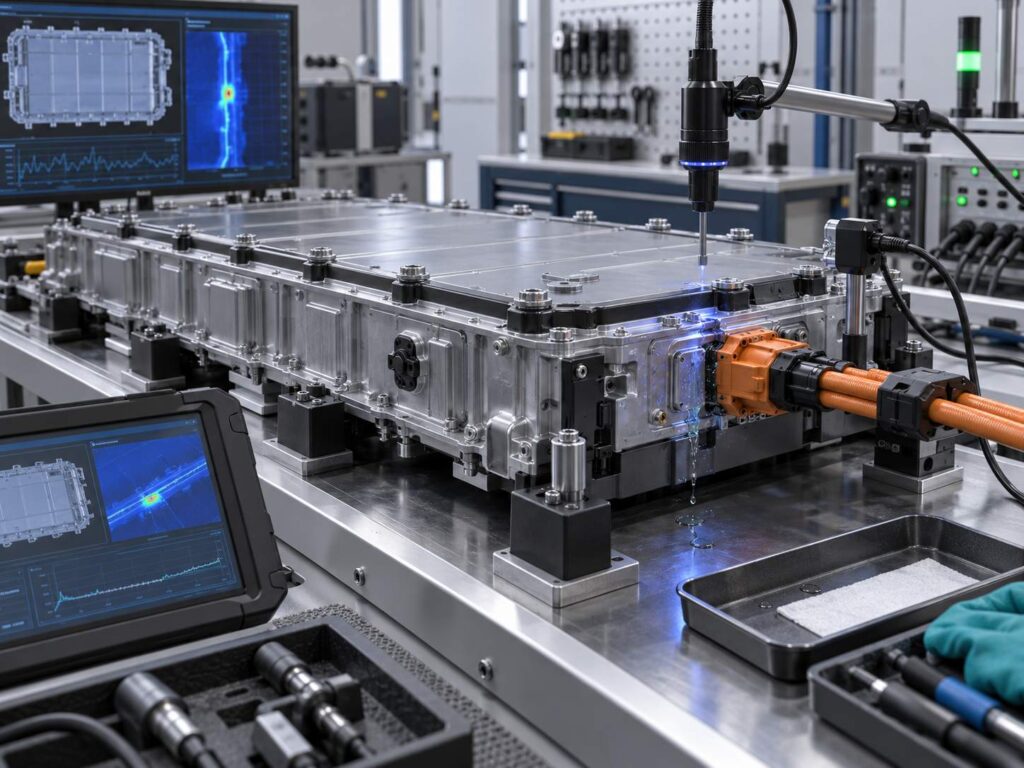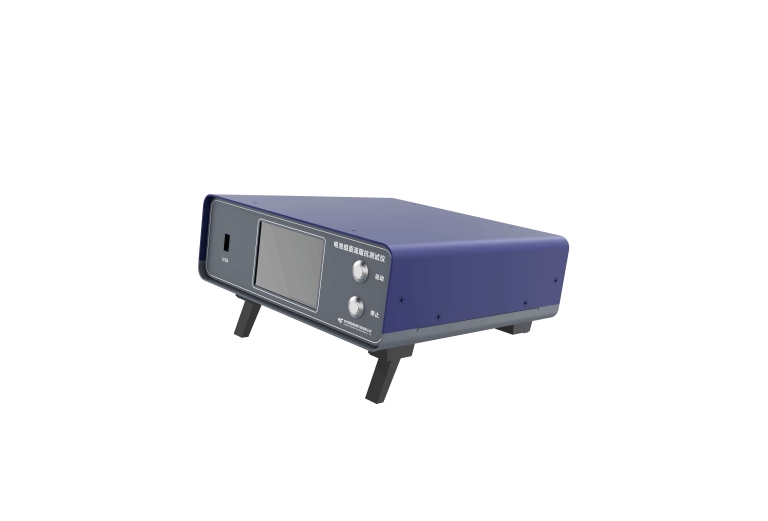

For new-energy vehicles, the power battery pack is a core component, and its safety and stability depend heavily on the sealing integrity of the enclosure. If air tightness is insufficient, the consequences can be serious: liquid water may cause insulation failure, short circuits, or even thermal runaway, while long-term exposure to dust and moisture can accelerate cell-terminal corrosion, increase internal resistance, and severely reduce driving range. Insufficient air tightness can also cause pressure imbalance inside the battery pack, affecting the normal opening of the pressure-relief valve and creating a major risk to driving safety. During battery manufacturing and maintenance, efficient and accurate air-tightness testing is a critical process for protecting safety throughout the battery life cycle. As a technology and equipment provider focused on the new-energy after-sales market, Guheng Energy provides customers worldwide with precision testing support ranging from individual battery leak testers to complete solutions, addressing common sealing-failure challenges.
Industry Challenges: Massive Losses Caused by Tiny Leaks
In B2B production and after-sales service environments, air-tightness testing faces complex and varied challenges. The following summarizes the core pain points and their corresponding application scenarios.
1. Insufficient Testing Accuracy Creates False Passes
Many traditional methods, such as bubble testing, are strongly affected by human judgment and cannot quantify tiny leaks. In the production of liquid-cooling plates, battery-pack enclosures, and other components, insufficient air tightness often appears as microleaks below 50 Pa/min. When conventional instruments lack sufficient resolution or pressure stability, defective products may reach the market, triggering batch recalls, major financial losses, and a serious crisis of brand trust.
2. Low Testing Efficiency Constrains Production Capacity
Production-line takt time requires fast testing, but some air-tightness testers require too much time for pressurization, stabilization, and measurement. For example, large battery enclosures have a high internal volume. Without automatic pressure regulation and rapid stabilization, a single test may take 3 to 5 minutes, significantly limiting production efficiency.
3. Adaptation Challenges Under Complex Operating Conditions
From pressure-relief valves and liquid-cooling plates to complete battery-pack assemblies, the physical structures and sealing characteristics of the test pieces can differ greatly. Standard testing equipment often cannot flexibly accommodate different pressure ranges and may lack dedicated fixtures, resulting in poor sealing or failed tests.
Guheng Energy: An Integrated Solution Combining High Precision and High Efficiency
To address these challenges, we draw on more than a decade of industry experience and the high air-tightness requirements of CTP battery structures to provide a range of high-performance testing systems. We provide more than standalone instruments: high-precision sensors, proprietary pressure-control algorithms, and modular fixtures work together to deliver an accurate testing experience with zero-error goals.
1. Portable Air-Tightness Leak Tester QMM-AK2-2: A Flexible, Precise Field Expert
Designed for after-sales maintenance and production-line sampling, the Guheng Energy QMM-AK2-2 portable air-tightness leak tester combines portability with high precision:
Core technical strengths: Proprietary pressure-control technology enables automatic adjustment and stable control of test pressure from 0.2 to 650 KPa. A pressure range of ±750 KPa combined with 1 Pa resolution ensures that even tiny leaks can be quantified accurately.
Scenario-based capabilities: The tester supports customized test workflows and cloud connectivity. When testing a battery pack after repair, field engineers can deploy it quickly, operate it through a clear 7-inch Android display, and generate a detailed report immediately, including scan data.
Structural reliability: A CNC-machined aluminum integrated pneumatic base and a dedicated liquid-protection design significantly improve durability in demanding maintenance environments and help prevent liquid backflow from damaging the equipment.
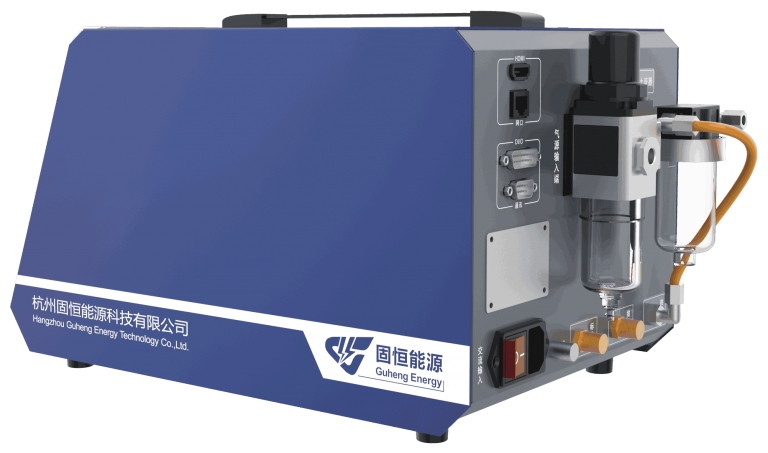
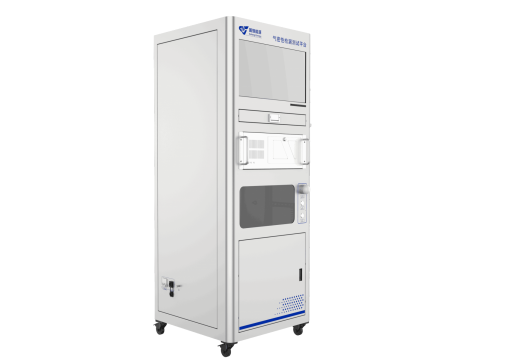
2. Air-Tightness Leak Testing Platform QMP-ZK1-1: A High-Performance Integrated Platform for Production Lines
For mass-production lines and high-standard laboratory testing, we recommend the QMP-ZK1-1 air-tightness leak testing platform. It delivers outstanding performance in precision testing and connection with production-line MES systems:
Performance and parameters: The test-pressure range spans -70 KPa to 650 KPa, covering both negative- and positive-pressure testing. High-precision redundant sensors and 1 Pa resolution meet demanding inspection requirements for IP67 and IP68 protection levels.
Efficient integration: The platform provides I/O, RS485, CAN, and other communication interfaces for seamless connection to MES systems and automatic test-data uploads, making quality traceability easier. Scanning can automatically call up the matching test program, greatly reducing line changeover time.
Technology integration: The platform can be combined with dedicated accessories such as our screw-type explosion-proof valve gas-injection fixture. This creates a dedicated inspection station for specific components, including the sealing performance of an explosion-proof valve mounting surface, maximizing the effectiveness of air-tightness testing for CTP battery packs.
3. Complete Accessories and Custom Services: Keeping the Test Circuit Leak-Free
In addition to core testing instruments, we provide customized air-tightness testing fixtures and jigs. For example, our screw-type explosion-proof valve gas-injection fixture uses a two-in-one design that combines a sealing plug with a gas-injection interface. It delivers non-destructive, fast, and reliable dynamic sealing, solving the poor sealing and valve-body damage associated with traditional methods. This is an essential part of achieving an accurate end-to-end test circuit.
The Value We Deliver: Why Should Brand Owners Choose Us?
Choosing Guheng Energy as your battery maintenance and testing equipment supplier means receiving support that extends from a single instrument to a complete solution:
Risk reduction: High-precision testing prevents battery failures and quality disputes caused by insufficient air tightness, protecting your brand reputation.
Higher efficiency: Fast, stable, and easy-to-integrate equipment shortens test cycles and improves production and maintenance efficiency.
Technical compliance: Our equipment meets ISO 9001 quality-management-system requirements. With more than 30 patents and 28 software copyrights, our products are exported to more than 40 overseas countries and regions, including the United States, Europe, and Israel, and are trusted by leading companies such as CATL, BYD, BAIC New Energy, and Yutong Bus.
As new structures such as CTP technology and 4680 large cylindrical cells continue to emerge, battery-pack sealing designs are becoming more complex. This places higher demands on the precision, stability, and intelligence of air-tightness leak testing equipment.
Raise Your Battery Safety Testing Standards Today
Accurate air-tightness testing is the foundation of battery safety. We invite you to experience Guheng Energy’s expertise in battery leak testers and air-tightness leak testing equipment. Whether you need a cost-effective production-line solution or want to upgrade after-sales maintenance equipment, we can provide tailored technical support.
Contact the Guheng Energy technical team today to receive a dedicated air-tightness testing solution or apply for a free sample test.
FAQ
Q: What are the main standards for battery air-tightness testing?
A: Testing is primarily based on IP67 or IP68 protection-level requirements. Under the specified pressure, the test piece is typically held for 30 to 60 seconds, and the pressure leak rate is generally controlled within 50 Pa/min. The exact requirement depends on the company’s standard and the battery-pack volume.
Q: What is the biggest technical advantage of Guheng Energy’s air-tightness testers compared with competing products?
A: The core advantage is proprietary high-precision pressure-control technology, which provides automatic adjustment across a wide range of 0.2 to 650 KPa. A redundant ±750 KPa sensor design provides stable, 1 Pa-level resolution under complex operating conditions.
Q: What scenarios is the QMM-AK2-2 portable air-tightness leak tester designed for?
A: It is designed for new-energy after-sales maintenance sites, distributed battery service points, and production-line sampling. Its portability, optional built-in battery, Android operating system, and instant report-generation function enable rapid on-site retesting of battery packs and liquid-cooling plates.