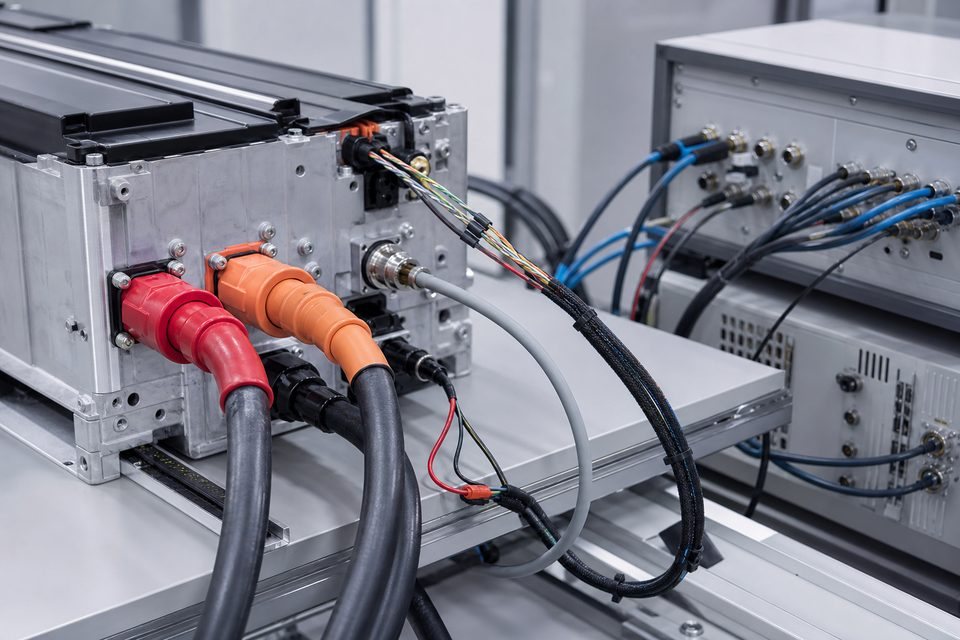

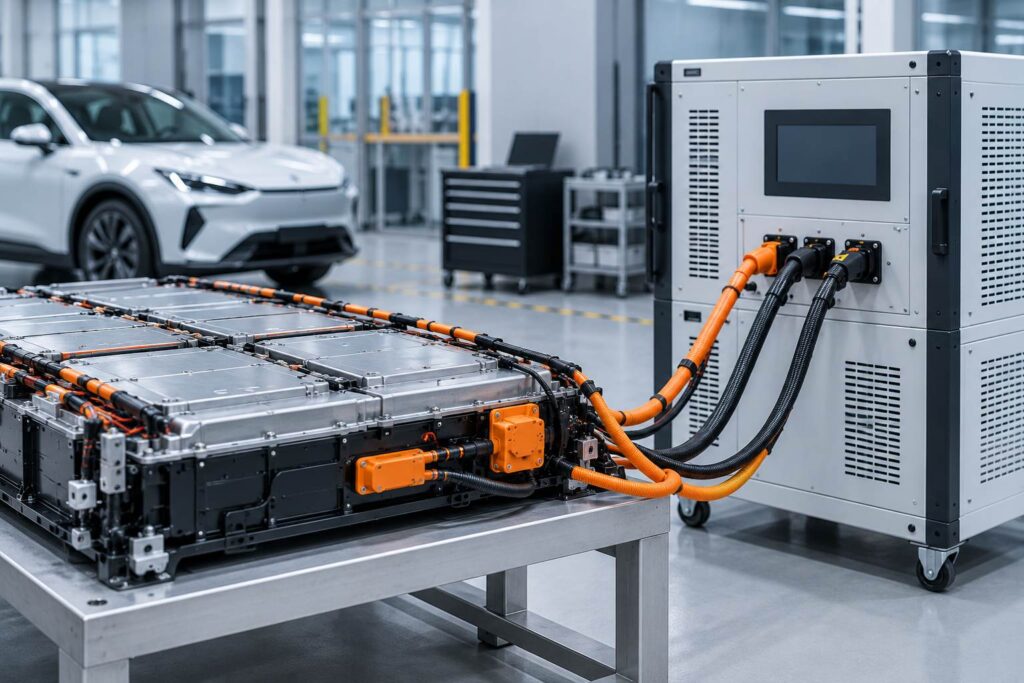
Battery repair risks do not come only from the battery itself. Reverse polarity, incorrect wiring, loose connections, incorrect parameter settings, overcharge, over-discharge, and abnormal temperature rise can all create hazards during maintenance. A professional battery charge and discharge tester should combine hardware error prevention, software process control, and multi-dimensional cut-off conditions to build multiple layers of protection for technicians, equipment, and the battery pack.
Why Does Battery Pack Repair Involve Significant Safety Risks
Why Must Reverse Polarity and Incorrect Wiring Be Prevented?
Battery pack maintenance may involve high-voltage cables, acquisition wires, communication lines, and different vehicle interfaces. If the entire process depends only on manual inspection, reverse polarity, incorrect acquisition wiring, missing connections, or loose cables may occur.
Related equipment from Guheng Energy includes protection for reverse connection, incorrect wiring, missing connections, short circuits, and communication loss. Automatic detection does not replace standard operating procedures, but it adds an additional layer of protection beyond manual inspection.
Why Can Overcharge and Over-Discharge Not Be Controlled by Pack Voltage Alone?
A traction battery contains many individual cells. Even when total pack voltage remains within the expected range, certain cells may already be approaching their individual voltage limits.
For this reason, a lithium battery charge and discharge tester should evaluate pack voltage together with cell voltage, SOC, capacity, and operating time instead of relying only on manual observation.
How Does a Battery Charge and Discharge Tester Build Hardware Protection
What Is the Role of Reverse Connection, Incorrect Wiring, and Cable-Loss Protection?
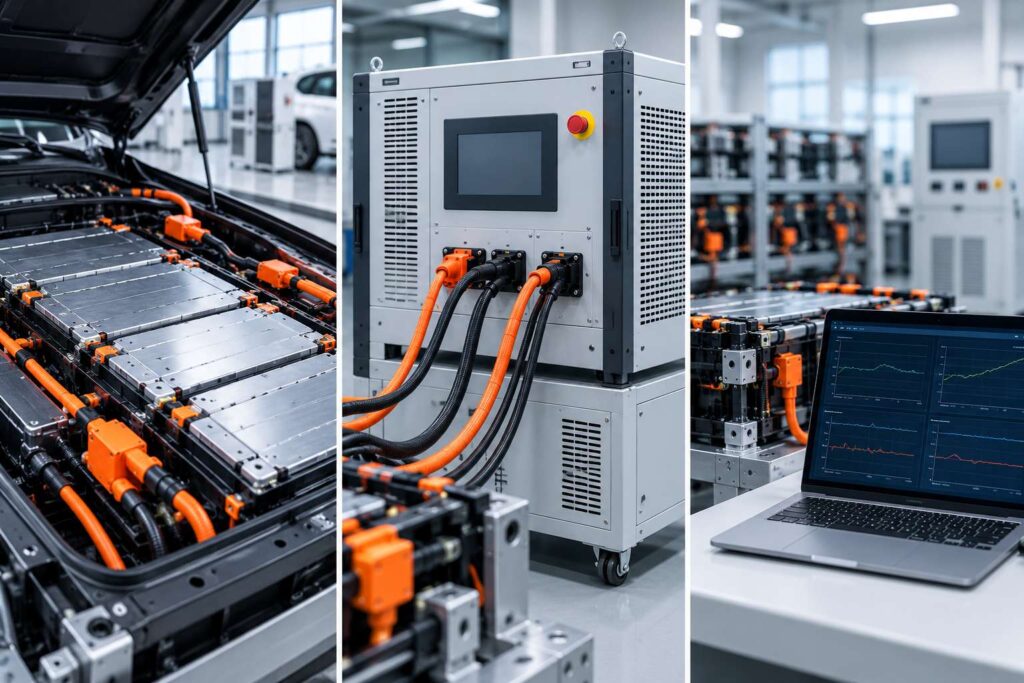
Before testing begins, operators need to confirm:
- Positive and negative terminal connection
- High-voltage cable condition
- Cell acquisition line position
- BMS communication status
- Battery voltage range
Relevant PBM Series equipment from Guheng Energy includes reverse connection, incorrect wiring, and cable-loss protection. When abnormal connections are detected, equipment-level protection can help prevent the incorrect operation from continuing.
How Do Overcurrent, Overvoltage, and Overtemperature Protection Work?
During a test, abnormal output conditions or sudden changes in battery status may also occur.
Related PBM equipment from Guheng Energy includes protections for input and output overcurrent, overvoltage, output short circuit, reverse connection, incorrect wiring, cable loss, and overtemperature.
Therefore, when selecting a battery pack charge and discharge tester, buyers should not compare only maximum voltage, current, and power. Fault detection and automatic protection logic are equally important.
How Does Software Create a Second Layer of Protection
Why Are Multi-Step Test Processes Safer?
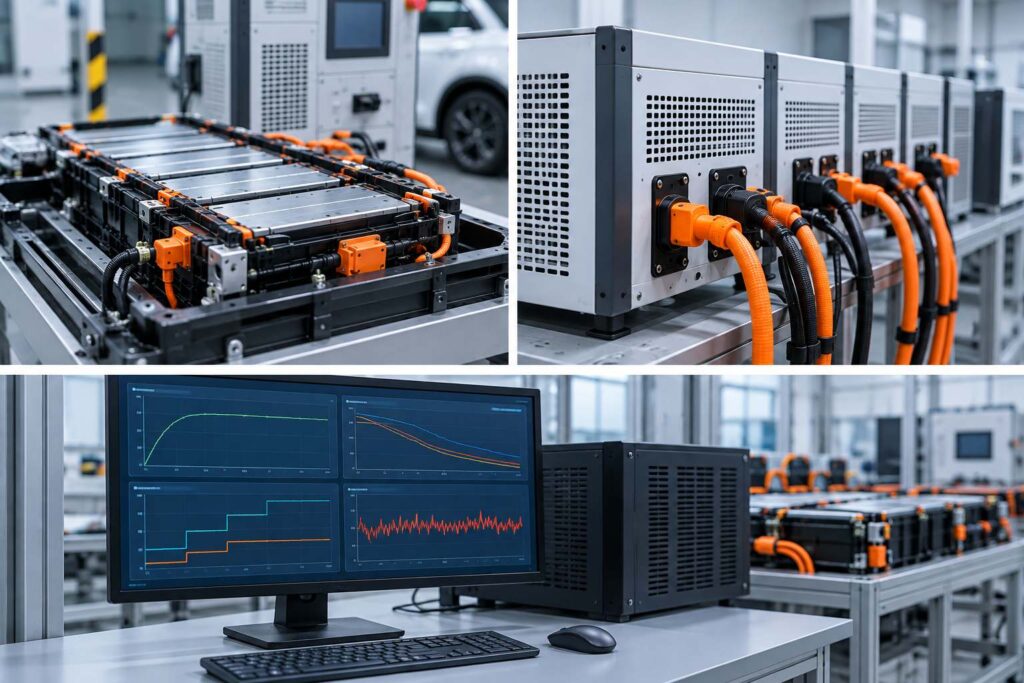
Battery capacity testing often involves several stages, such as charging, rest, discharge, and SOC recovery. If operators repeatedly change settings manually, steps may be missed or parameters may be entered incorrectly.
The PBM-MW Series from Guheng Energy supports both single-step and multi-step operation. It also provides voltage, capacity, and time-based cut-off conditions together with individual cell voltage acquisition and BMS CAN communication.
Predefined test procedures improve consistency between operators and reduce unnecessary manual switching.
What Is the Difference Between Step-Level and Global Protection?
Step-level protection determines when the current charging, discharging, or resting stage should end. Global protection focuses on whether the entire test process must stop.
For example, a discharge step may be programmed to end at a target capacity or time. However, if one cell reaches its protection limit early, the system should not continue simply because the programmed step has not yet finished.
Combining both levels of protection helps prevent a test from continuing after the battery has already entered an abnormal state.
How Do Multi-Dimensional Cut-Off Conditions Reduce Overcharge and Over-Discharge Risks?
Why Is One Cut-Off Condition Not Enough?
Relevant PBM-B Series equipment from Guheng Energy supports multiple cut-off conditions, including pack voltage, capacity, SOC, operating time, and individual cell voltage. Battery voltage and temperature acquisition can also be expanded.
Each parameter serves a different purpose:
- Pack voltage reflects overall electrical status
- Cell voltage identifies local abnormalities
- SOC controls the target state of charge
- Capacity limits accumulated charge or discharge
- Time limits test duration
- Temperature helps identify abnormal thermal conditions
Using several conditions together is more suitable for complex traction battery maintenance than relying on a single voltage threshold.
Why Should Protection Parameters Not Be Copied Between Batteries?
Different battery chemistries, rated voltages, capacities, and BMS strategies have different operating limits. Before testing, technicians should confirm voltage, current, SOC, cell voltage, and temperature requirements from the battery technical documentation.
A battery charge and discharge tester can only provide effective protection when the test parameters are configured correctly.
How Does Guheng Energy Apply Protection to Battery Maintenance Equipment
How Does the PBM Series Support Battery Pack Maintenance
The PBM-MW Series from Guheng Energy can be used for charging, discharging, and SOC adjustment of battery modules and small battery packs. It supports individual cell voltage acquisition, BMS CAN communication, multi-step operation, and test data recording.
The PBM-B Series is designed for battery pack charge-discharge maintenance and can combine multiple cut-off conditions with voltage and temperature acquisition.
This means a lithium battery charge and discharge tester is not only responsible for energy input and output. It must also perform data acquisition, safety cut-off, and process management.
What Can Be Learned from a Real Maintenance Case?
In a published new-energy vehicle after-sales maintenance case, a project using battery pack handling equipment together with the BST-DW260 testing system achieved a 40% reduction in average inspection time and improved fault diagnosis accuracy to more than 98%. Battery capacity calculation was also used to support after-sales decision-making.
The value of such a process is not only faster testing. It also reduces dependence on individual technician experience by introducing standardized procedures and measurable data into battery maintenance.
How Can a Complete Battery Repair Safety Loop Be Built
A practical process can include:
- Inspect the battery and wiring before testing
- Confirm equipment connection and communication status
- Set voltage, SOC, capacity, and temperature limits
- Monitor key data throughout the test
- Stop testing according to protection logic when abnormalities occur
- Save test data and reports after completion
This creates a closed-loop process covering inspection, confirmation, monitoring, protection, review, and record keeping.
Conclusion
Battery repair safety should not depend entirely on operator experience. A more reliable approach is to use a battery charge and discharge tester that combines wiring-error protection, electrical protection, software process control, multi-dimensional cut-off conditions, and data recording.
For vehicle manufacturers, battery producers, after-sales service centers, and energy storage maintenance teams, an effective safety system should combine manual inspection with automatic protection to reduce the risks associated with reverse polarity, overcharge, over-discharge, and abnormal temperature rise.
Explore Guheng Energy battery charge-discharge maintenance and testing solutions to build a more complete hardware and software safety system for battery repair.
FAQ
Q: How does a battery charge and discharge tester prevent reverse battery connection?
A: A battery charge and discharge tester can use reverse-polarity detection and equipment protection to stop normal testing when an incorrect connection is detected. Manual wiring inspection and standard operating procedures should still be used together with automatic protection.
Q: How does a lithium battery charge and discharge tester prevent overcharge and over-discharge?
A: A lithium battery charge and discharge tester can combine pack voltage, cell voltage, SOC, capacity, and time-based cut-off conditions to determine whether charging or discharging should continue.
Q: Why does a battery pack charge and discharge tester need temperature protection?
A: Temperature provides thermal-state information that voltage and SOC cannot fully reflect. Abnormal temperature rise can support automatic protection decisions and provide additional evidence for fault diagnosis.
Q: What safety protections are available in Guheng Energy battery maintenance equipment?
A: Relevant Guheng Energy equipment includes protection for overcurrent, overvoltage, short circuit, reverse connection, incorrect wiring, cable loss, overtemperature, and communication abnormalities.
Q: What is the difference between step-level and global protection in a battery charge and discharge tester?
A: Step-level protection controls when an individual test stage ends, while global protection monitors safety limits across the entire test process. Using both helps prevent continued operation when the battery has already entered an abnormal condition.