
To select a battery pack air tightness tester, define the test part, pressure, method, air supply, fixture interface, cycle time, and data requirements before comparing instruments. Guheng Energy’s QMM series is designed for sealing tests on battery enclosures and related new-energy components, while the available pressure and method depend on the selected configuration.
Match the Air Tightness Tester to the Test Part
Battery packs, cooling plates, electric-drive assemblies, PDU units, and PEU units differ in internal volume, seal geometry, and port design. A useful request for quotation should include part volume, allowable pressure, test-port details, rejection limit, target cycle time, and fixture requirements.
Battery Enclosures and Multiple Seal Points
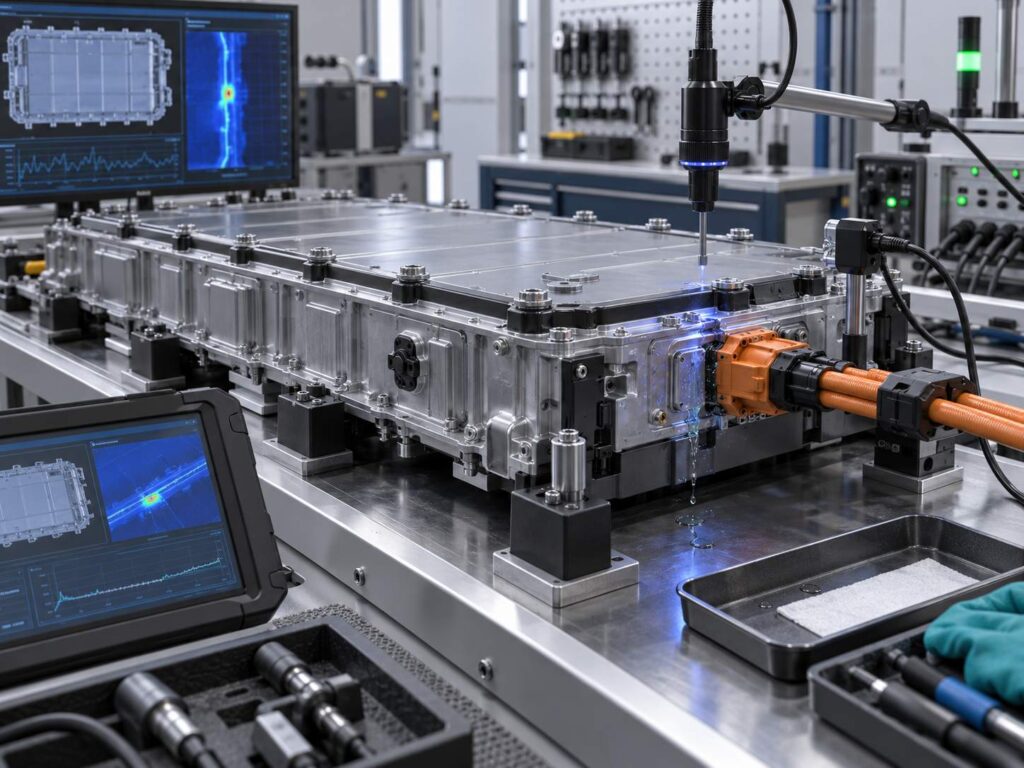
A battery enclosure may include a lid seal, connectors, a pressure-relief device, and cooling interfaces. The process must separate filling, stabilization, and measurement so that structural deformation, temperature drift, or fixture leakage is not mistaken for leakage from the part.
Cooling Plates and Liquid Protection
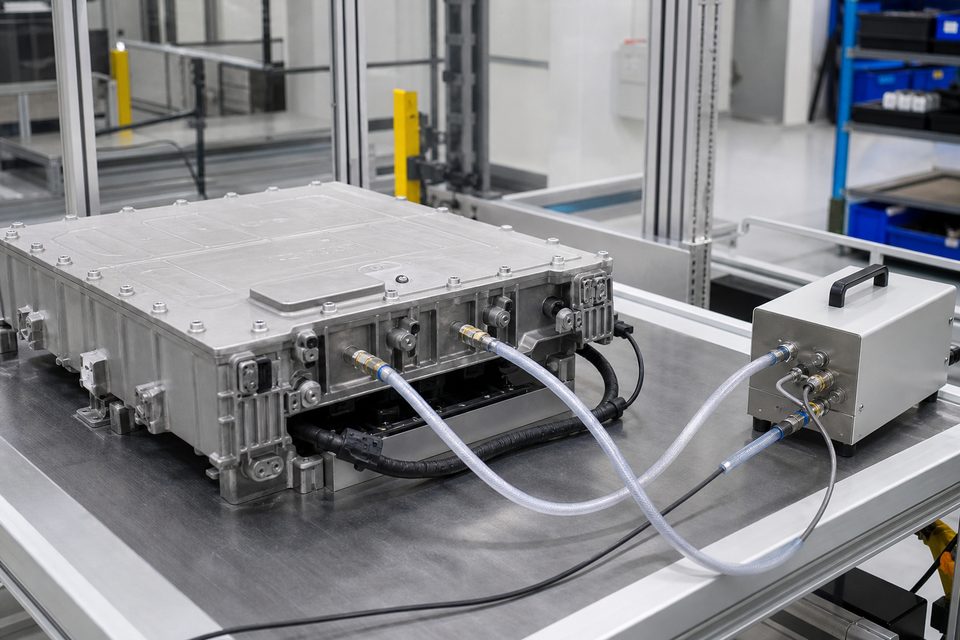
Cooling plates combine small internal channels with several connection points, and residual liquid can threaten the instrument. The QMM design uses a liquid stopper and an independent exhaust path, giving buyers specific protection and maintenance features to evaluate.
Choose Between Direct Pressure and Differential Pressure
When Direct Pressure Testing Fits
Direct pressure testing observes pressure change inside the test part. Its performance depends on part volume, stabilization time, temperature, and fixture sealing, so parameters should be validated with representative good and defective samples instead of copied from another project.
When Differential Pressure Testing Fits
Differential pressure testing compares the test part with a reference side and can help resolve small pressure changes. Reference volume, temperature balance, and tubing layout remain important, and buyers should confirm which method is supported by the exact configuration being quoted.
Verify the Main Technical Parameters
Pressure Range and Air Supply
The QMM-WZ-C-C0 provides a test-pressure output range of 0.2–650 kPa, automatic pressure adjustment, a sensor range of ±750 kPa, and 1 Pa test-pressure resolution. Its air supply should be clean, dry compressed air at no more than 1 MPa; the final technical agreement should confirm the complete configuration.
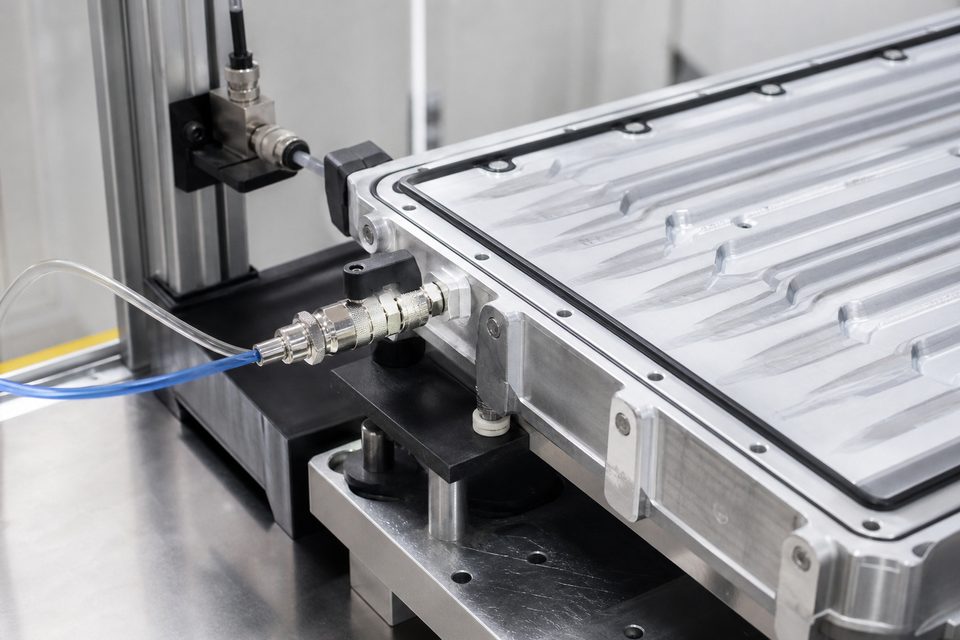
The QMM portable air tightness leak tester is designed for sealing tests on battery enclosures and related new-energy components. Pressure range, air supply, fixtures, and communication options should be confirmed at model level.
Part Volume, Cycle Time, and Repeatability
The QMM-WZ-C-C0 supports test objects with a volume greater than 0.5 litre, but different volumes cannot be assumed to share the same cycle time. Larger parts can require different filling and stabilization settings, so acceptance should use representative parts and the intended fixture.
Data Interfaces Determine Workflow Value
Recipe and Report Management
Editable test processes, parameter files, barcode input, and report output support traceability in service and production environments. When one tester serves several products, buyers should define recipe control, permissions, result naming, and retest rules.
MES and External Control
The QMM series offers optional I/O, RS485, and CAN interfaces for external control and data exchange. A purchase specification should define the protocol, fields, triggers, offline storage, and result-upload logic rather than stating only that MES is supported.
The automotive battery air tightness solution explains the typical sealing-test workflow, while the Guheng Energy product portfolio helps buyers coordinate testing, maintenance, safety, and fixture requirements.
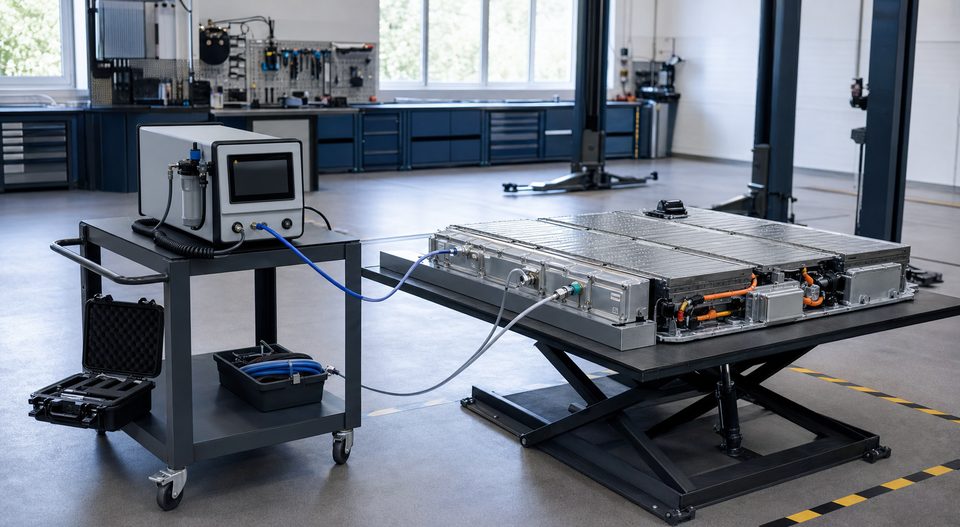
Where the Guheng Energy Solution Fits
The QMM series is relevant to new-energy test applications that require field deployment, managed recipes, report output, or a customized pneumatic fixture. Production buyers should focus on cycle time, automation, and MES integration, while service buyers should prioritize portability, air-supply conditions, fixture changeover, and permissions.
Conclusion
A battery pack air tightness tester should be purchased against an acceptance-ready specification covering the part, method, pressure, volume, cycle time, fixture, and data interface. Guheng Energy can be considered for QMM equipment and fixture support, with the final configuration checked with actual samples.
FAQ
Q: Should I choose direct or differential pressure testing?
A: Choose according to part volume, allowable pressure, leak limit, cycle time, and environmental stability. Direct pressure testing is structurally straightforward, while differential testing compares the part with a reference. Both are affected by temperature, stabilization, and fixture leakage, so validation with representative good and defective samples is essential.
Q: What pressure range does a battery pack test require?
A: The required range must come from the battery pack’s allowable test pressure and the company’s inspection specification, not from the tester’s maximum output alone. Excess pressure can deform an enclosure, while insufficient pressure can reduce discrimination. Provide volume, test port, target pressure, leak limit, and cycle time.
Q: Can a portable tester connect to MES?
A: The QMM series offers optional I/O, RS485, and CAN interfaces and related data-exchange functions. Compatibility with an existing MES depends on protocol, fields, software configuration, and integration scope. The contract should specify communications, buffering, report format, result upload, and commissioning acceptance.
Q: What information should be included in an RFQ?
A: Include part drawings, internal volume, sealing ports, test pressure, allowable leakage, cycle time, air and power conditions, fixture quantity, and data-upload requirements. For a multi-product station, also define changeover time, barcode rules, user permissions, recipe control, and the required report template.