

The key to selecting explosion-proof transport containers for hazardous power batteries is not simply choosing the largest possible container, but rather ensuring that the structure, materials, pressure relief path, and on-site handling procedures are compatible. Guheng Energy‘s TEPB series is designed for the placement and transport of power lithium batteries that may pose safety hazards, helping to reduce the environmental impact of battery runaway or fire.
Why can’t faulty power batteries be transported in ordinary containers?
The risks are more concentrated in the maintenance and testing process.
Batteries undergoing unpacking, repair, return for testing, and recycling may have issues such as unclear charge levels, localized overheating, or damaged casings. Standard transport boxes primarily address handling issues and lack structural design to withstand abnormal pressure and flame damage, thus they cannot replace specialized protective containers.
Physical isolation is required for safe transportation.
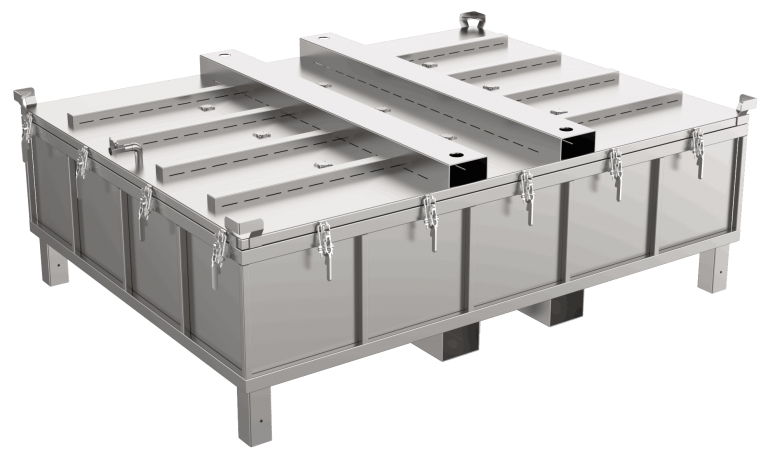
When problematic batteries need to be transferred from the repair station to an isolation area, testing area, or recycling area, the container should first ensure reliable isolation between the battery and the surrounding environment. The value of the transport container lies in moving risk control forward, allowing companies to add a stable physical layer of protection beyond routes, personnel, and emergency procedures.
The core structure of the explosion-proof transport box for hazardous waste power batteries
304 stainless steel and layered structure
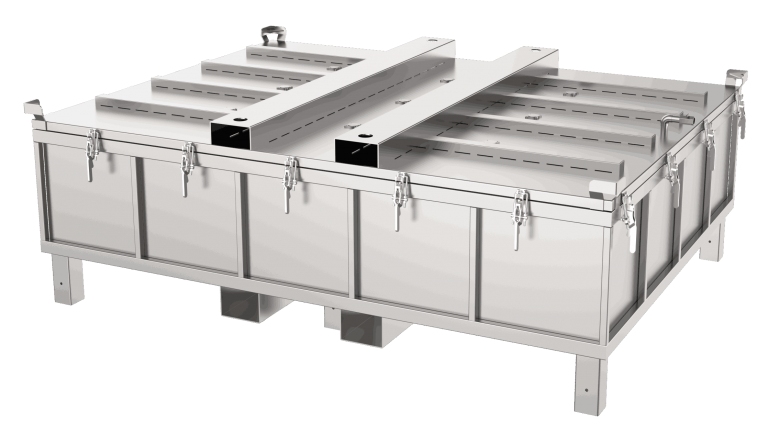
The TEPB series is made of 304 stainless steel and is available in double-layer and single-layer structures. The stainless steel enclosure provides robust external protection, and the structural form can be selected according to battery status, turnover distance, and site space. The final selection still needs to be made based on the actual battery pack dimensions.
Pressure relief valve, safety valve and explosion-proof mesh
Pressure relief valves and safety valves provide controlled pressure relief channels when the internal pressure of the enclosure abnormally increases, while explosion-proof mesh helps reduce the risk of flames, debris, and high-temperature media spreading outwards. The 0.5 MPa explosion-proof pressure and IP65 protection rating reflect the protection capability of Guheng Energy’s explosion-proof transport enclosure under specific test conditions. In actual projects, its applicability should be confirmed in conjunction with the application environment, operating conditions, and relevant testing standards to avoid equating a single parameter with absolute safety guarantees for all abnormal situations.
How to arrange safe turnover in different sites
Auto repair shops and after-sales service
When a service station is disassembling a battery pack, awaiting testing, or replacing a module, it should first establish a process for status confirmation, isolated placement, and transfer registration. Explosion-proof transport boxes can serve as fixed turnover nodes, assisting in battery discharge status confirmation, visual inspection, and necessary airtightness testing, thereby reducing the prolonged stay of problematic batteries in open workstations.
Energy storage power stations and recycling
Energy storage systems are large-scale, and individual faulty modules often need to be isolated from the system before being transferred to a dedicated area for handling. Using specialized transport containers allows on-site personnel to complete the transfer according to a unified route and operating requirements, but the containers cannot replace fire protection, monitoring, isolation distances, and professional emergency plans.
What should be checked when selecting explosion-proof transport boxes from Guheng Energy?
Before selecting a battery pack or module, its shape, weight, handling method, and loading/unloading space should be confirmed. Truly effective protection comes from the coordination between container design and processes, including battery status verification, packing inspection, route management, anomaly monitoring, and isolation storage upon arrival. While Guheng Energy’s explosion-proof transport containers can serve as physical equipment in a safety closed loop, companies still need to develop comprehensive systems based on their own site conditions and regulatory requirements.
conclusion
The transportation risks of hazardous waste power batteries cannot be fully summarized by a single parameter. A reliable solution should simultaneously consider the enclosure structure, pressure relief design, waterproofing capability, loading and unloading conditions, and emergency procedures. Guheng Energy’s TEPB series integrates a 304 stainless steel enclosure, pressure relief valve, safety valve, and explosion-proof mesh into professional transport equipment, providing a clearer safety management approach for maintenance, energy storage, and recycling scenarios.
Safe battery turnaround solutions suitable for your field processes through Guheng Energy.
FAQ
Q: Can explosion-proof transport boxes transport all power batteries?
A: Not all power batteries are suitable for the same enclosure. The battery pack dimensions, weight, condition, risk level, and transport route should be confirmed, and the enclosure structure, load-bearing capacity, and pressure relief configuration should be verified. Batteries that are smoking, continuously heating up, or visibly damaged should be handled according to emergency procedures.
Q: What does 0.5MPa represent in the TEPB series?
A: 0.5MPa is labeled as explosion-proof pressure, but its complete test conditions and specification definitions still need to be confirmed. Before use, it should be clarified whether this value belongs to the design pressure, test pressure, or other specification, and the applicable boundaries should be specified in the technical documents.
Q: Does IP65 mean that the battery is completely waterproof during transportation?
A: IP65 is the enclosure protection rating, which does not mean that water will not enter in all transportation environments, nor can it replace packaging sealing, rain management, and arrival inspection. Actual solutions should also consider the vehicle, loading and unloading area, risk of water accumulation, and the condition of the enclosure doors and interfaces.
Q: Can explosion-proof transport containers replace fire-fighting and emergency facilities?
A: No. Explosion-proof transport containers primarily provide physical isolation and pressure relief; on-site facilities such as fire protection, monitoring, isolation zones, personnel training, and emergency response plans are still required. High-risk batteries should be assessed by professionals, and transfer and disposal procedures should be implemented accordingly.