
In the actual operation of energy storage power stations, excessive voltage drop in battery packs is the primary cause of system capacity degradation, shortened cycle life, and even frequent safety accidents. Taking the CGN Jiuquan microgrid energy storage power station as an example, after four years and eight months of operation, the 20MW/40MWh project experienced a drop in effective system capacity from 20MWh to 13.5MWh, a decrease of 33.5%, due to a decrease in the cell voltage consistency qualification rate to 89.50% and a maximum voltage deviation as high as 128mV. This resulted in a reduction of 1.07 million yuan in annual power generation revenue. This case reveals the severity of the voltage drop problem: when the maximum voltage deviation within a cluster exceeds the 50mV requirement of the national standard GB/T 36276, the high-degradation cells will limit the depth of charge and discharge of the entire battery pack, forming a typical “weakest link” effect.
Why do traditional BMS systems struggle to curb differential voltage deterioration? The key lies in three major limitations of their built-in balancing strategies: the balancing current is only 50-200mA, insufficient to handle capacity deviations exceeding 5%; the coupling effects of multi-dimensional parameters such as cell internal resistance and temperature are not considered; and the ability to predict degradation trends prevents preventative intervention. To truly solve the differential voltage problem, high-precision detection equipment and active balancing technology must be introduced — this is precisely the core value of Guheng Energy. As a professional manufacturer deeply rooted in the new energy aftermarket maintenance field, we provide a complete set of practical tools, from battery pack differential voltage detection methods to battery balancing implementation.

High-precision detection: the “gold standard” for differential pressure diagnosis.
Why does accuracy determine success or failure?
In energy storage systems, voltage differences between battery cells are often at the millivolt level. Insufficient accuracy of detection equipment can lead to three serious consequences: first, it fails to identify early voltage differential problems, missing the optimal intervention window; second, it misjudges “pseudo-healthy” cells, resulting in ineffective balancing; and third, it fails to provide reliable data support for battery balancing strategies. In a real-world application, an energy storage operator misclassified a batch of battery packs with actual voltage differentials reaching 80mV as “qualified” due to the use of a low-precision voltmeter (error ±10mV). Three months later, this batch of battery packs suffered thermal runaway due to overcharging, resulting in direct economic losses exceeding 2 million yuan.
Solid Energy’s Precision Solutions
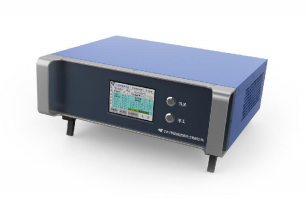
To address the aforementioned pain points, Guheng Energy has launched the BWT series of battery voltage acquisition instruments. This device features a 2.8-inch TFT high-definition LCD touchscreen display, multi-channel parallel acquisition capabilities, and represents three major breakthroughs in battery pack differential pressure detection methods:
Breakthrough in accuracy: The measurement accuracy reaches ±1mV, which can accurately capture the static voltage and dynamic voltage fluctuations of each individual battery cell, and completely eliminate misjudgments caused by wiring harness voltage difference or loose connectors.
Breakthrough in efficiency: Supports USB flash drive data storage and automatic alarm functions, allowing maintenance personnel to complete battery differential pressure tests on-site at the battery cluster, reducing single inspection time by more than 80%.
Breakthrough in compatibility: Compatible with various battery systems such as lithium-ion and lead-acid, adapting to different energy storage scenarios.
In a practical application at a 20MWh energy storage power station in Gansu, the operation and maintenance team used the BWT series battery voltage data acquisition instrument to conduct a survey of 1,960 battery packs and accurately identified 327 packs with excessive differential pressure, providing a reliable data foundation for subsequent equalization maintenance .
Active balancing: From “passive repair” to “active intervention”
Limitations of passive equilibrium
Traditional BMS (Battery Management System) uses passive balancing (dissipative balancing) to dissipate excess energy from high-voltage cells through resistor discharge. While this method is simple and low-cost, it has fundamental flaws: the balancing current is extremely small (typically 50-200mA), making it essentially ineffective for battery packs with capacity deviations exceeding 5%; energy is dissipated as heat, leading to localized temperature rises and further exacerbating battery inconsistency. This is precisely why many energy storage projects experience a concentrated outbreak of differential pressure problems after 2-3 years of operation.
The technical advantages of active balancing
True battery balancing should be based on the concept of “energy transfer,” transferring charge from high-energy cells to low-energy cells, rather than simply dissipating it. Guheng Energy’s portable 48V micro-hybrid battery pack maintenance device embodies this concept. This device employs active balancing technology, achieving an energy transfer efficiency of over 90%, enabling precise repair of battery packs with voltage differences.
In a case study involving bulk maintenance at a car-sharing operations center, technicians used a portable 48V mild-hybrid battery pack maintenance device to perform offline maintenance on dozens of battery packs. Through several cycles of active balancing, the overall voltage differential was reduced from over 80mV to below 15mV, restoring over 90% of the vehicle’s range. This case clearly demonstrates that high-precision detection combined with active balancing can eliminate voltage differential problems at their root.
CTP technology: A leap in precision from the module level to the cell level
New challenges to detection accuracy from architecture
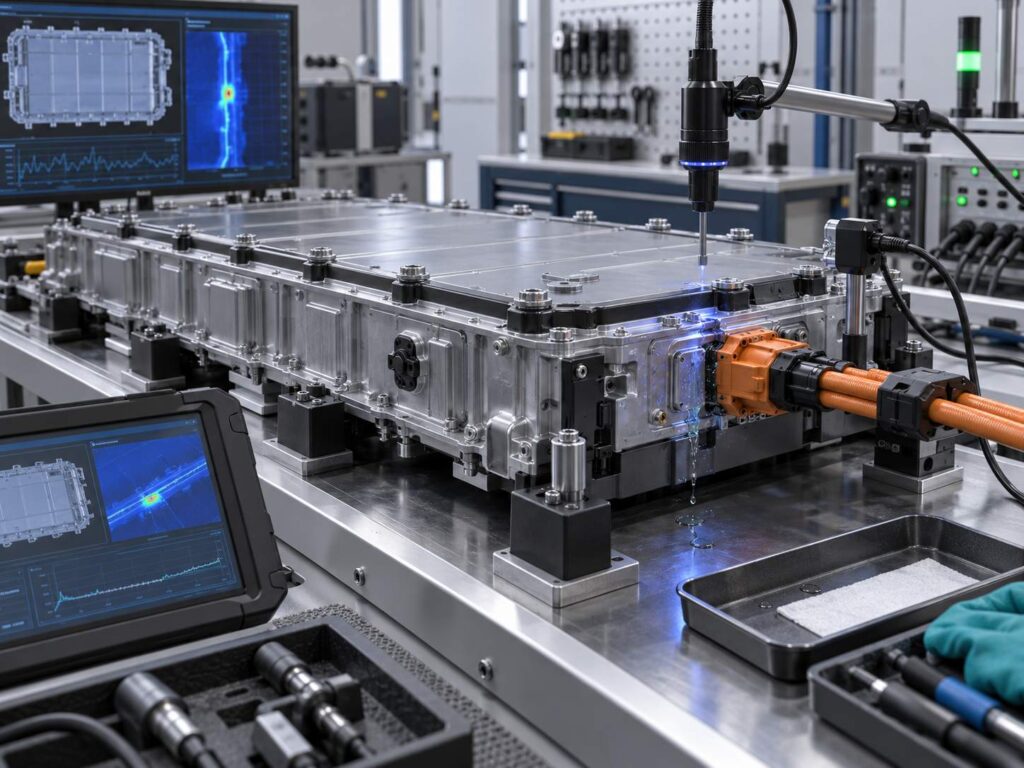
With the rapid adoption of CTP (Cell to Pack) technology in the energy storage field, the traditional module-level monitoring layer has been removed, placing higher demands on differential pressure detection. In the CTP architecture, anomalies in a single cell directly affect the performance of the entire battery pack, and due to the lack of module-level buffering, differential pressure problems deteriorate much faster. This means that battery differential pressure testing must be moved down from the module level to the cell level, requiring an order of magnitude improvement in detection accuracy.
Solid Energy’s CTP Testing Solution
To address the unique structure of CTP battery packs, Guheng Energy has developed a combined solution of a battery pack charge/discharge tester and a CNC cell stacking extrusion machine. The CNC cell stacking extrusion machine boasts a repeatability accuracy of ±0.05mm and a pressure adjustment range of 0-1200kg, ensuring mechanical consistency during cell stacking and reducing the probability of differential pressure buildup from the outset.
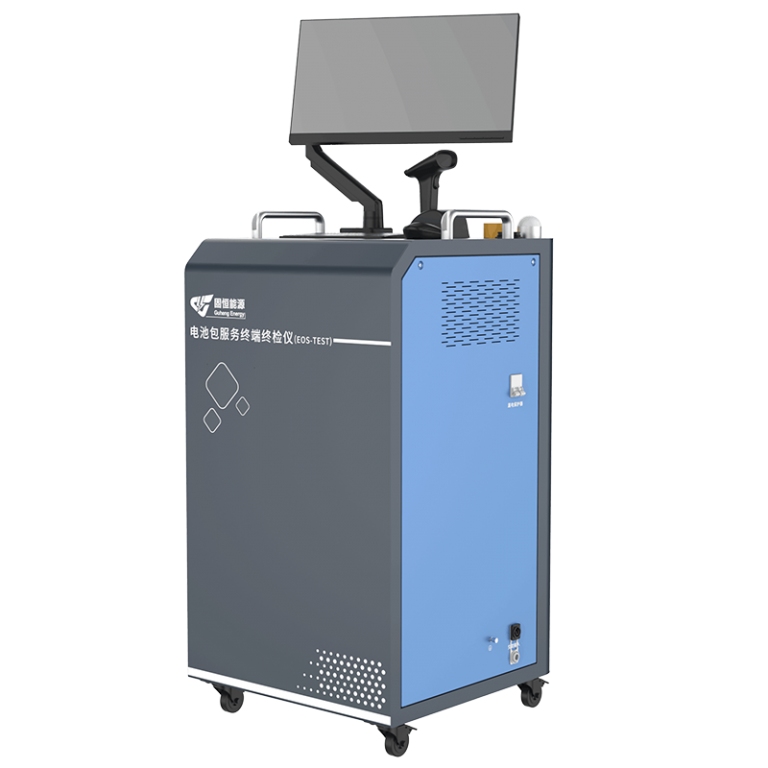
In the testing phase, the battery pack charge/discharge tester performs a full charge and discharge test on the entire pack to accurately assess the capacity and internal resistance distribution of each cell, screening out substandard cells that have “normal voltage but significantly reduced capacity.” This end-to-end testing capability, from the cell level to the pack level, is a core highlight of Guheng Energy’s CTP technology.
Real-world application case: Finding value in data
Case 1: A 50MWh grid-side energy storage power station in East China
After three years of operation, the battery pack voltage differential generally exceeded 60mV, and the system’s usable capacity decreased to 82% of its initial value. The operation and maintenance team introduced a complete testing and maintenance solution from Guheng Energy: First, a BWT series battery voltage acquisition instrument was used to conduct a pack-level voltage survey of the entire station to locate abnormal cells; then, a portable 48V micro-hybrid battery pack maintenance instrument was used for offline active balancing; finally, a battery pack charge and discharge tester was used to verify the repair effect. After two rounds of maintenance, the overall station voltage differential was controlled within 25mV, the system’s usable capacity recovered to 93%, and the annual power generation revenue increased by approximately 800,000 yuan.
Case 2: Battery Asset Operation Project of a Battery Swapping Station in South China
The project operated over 500 battery swapping packs, which frequently experienced differential pressure issues due to high-frequency use, resulting in an average annual battery degradation rate of 12%. After introducing the Guheng Energy maintenance system, a standardized process of “monthly inspection + quarterly balancing” was established. One year later, the average annual battery degradation rate dropped to 6.5%, the average lifespan of the battery packs was extended by 22%, and asset replacement costs were directly reduced by over 3 million yuan.
Accuracy determines safety; data drives operations and maintenance.
As energy storage systems move towards large-scale, long-cycle operation, battery pack differential pressure management has evolved from an “auxiliary maintenance” issue to a “core safety” issue. High-precision battery pack differential pressure detection methods are the eyes that discover problems, while efficient battery balancing technology is the hands that solve them. Guheng Energy provides a complete tool system that connects these two aspects.
Choosing Solid Energy means choosing:
- With a detection accuracy of ±1mV, no potential differential pressure hazard can escape detection.
- Actively balance core technologies to end the “weakest link” problem at its root;
- CTP full-chain testing solution covers the entire dimension from cell to package level.
Take immediate action to end the pressure differential problem.
Is your energy storage system facing issues such as excessive pressure differential and capacity degradation? Contact Guheng Energy now for a customized maintenance solution.
FAQ
Q: At what voltage differential of an energy storage battery pack does intervention need to be initiated?
A: According to the national standard GB/T 36276, intervention is required when the maximum voltage deviation within a cluster exceeds 50mV. It is recommended to use 30mV as the warning threshold; if this value is exceeded, battery voltage difference testing and equalization maintenance should be performed.
Q: What is the core difference between active equilibrium and passive equilibrium?
A: Passive balancing consumes excess energy through resistance, which is inefficient and generates significant heat; active balancing transfers energy from high-voltage cells to low-voltage cells, achieving an energy utilization rate of over 90%, making it suitable for large-capacity energy storage systems.
Q: Are the devices from Guheng Energy compatible with batteries from different brands?
A: Compatible. Our BWT series battery voltage acquisition unit supports multiple battery types, including lithium iron phosphate, ternary lithium, and lead-acid batteries, and features automatic gear selection.